Uses Of Materials Of course! The uses of materials are vast and fundamental to virtually every aspect of modern life. They can be categorized in many ways, but a common approach is to group them by the type of material and then explore their applications. Here is a comprehensive overview of the uses of materials, broken down into categories.
Metals
- Metals are typically hard, shiny, malleable, fusible, and ductile, with good electrical and thermal conductivity.
Steel (an alloy of iron and carbon):
- Construction: Skyscrapers, bridges, reinforcement bars (rebar) in concrete.
- Transportation: Car bodies, ships, railway tracks.
- Consumer Goods: Appliances (refrigerators, washing machines), cutlery, tools.
- Aluminum: Lightweight and corrosion-resistant.
- Transportation: Aircraft bodies, car parts, bicycles.
- Packaging: Beverage cans, foil wrappings.
- Construction: Window frames, roofing.
- Copper: Excellent electrical conductor.
- Electrical: Wiring, motors, transformers, and electronics.
- Plumbing: Pipes and fittings.
- Roofing: Durable and attractive architectural material.
- Titanium: High strength-to-weight ratio and biocompatible.
- Aerospace: Jet engines, spacecraft, military aircraft.
- Medical: Artificial joints, dental implants, surgical instruments.
- Consumer Goods: High-end sports equipment (golf clubs, bicycles).
- Gold & Silver: Corrosion-resistant and highly conductive.
- Electronics: Circuit boards, connectors (especially gold for reliability).
- Jewelry and Currency: Decorative and store of value.
Polymers (Plastics & Rubbers)
Polymers are large molecules made of repeating subunits. They are versatile, often lightweight, and can be flexible or rigid.
- Polyethylene (PE): The most common plastic.
- Packaging: Plastic bags, bottles, food containers, films.
- Polyvinyl Chloride (PVC): Durable and versatile.
- Construction: Pipes, window frames, siding, flooring.
- Healthcare: Blood bags, medical tubing.
- Polypropylene (PP): Resistant to heat and chemicals.
- Automotive: Car bumpers, battery cases, interior trim.
- Consumer Products: Yogurt containers, bottle caps, reusable food containers.
- Polyethylene Terephthalate (PET): Clear and strong.
- Packaging: Drink bottles, food containers.
- Textiles: Polyester fiber for clothing (often recycled from bottles).
- Polystyrene (PS): Can be rigid or foamed.
- Packaging: CD cases, disposable cutlery.
- Insulation: Foam board and loose-fill insulation (Styrofoam).
- Silicone: Heat-resistant and biocompatible.
- Bakeware: Spatulas, baking mats.
- Medical: Implants, tubing, catheters.
- Sealants: Adhesives and sealants in construction.
Ceramics
Ceramics are typically hard, brittle, heat-resistant, and corrosion-resistant materials made by firing non-metallic minerals at high temperatures.
Clay Products:
- Construction: Bricks, tiles, sewer pipes, toilet bowls and sinks.
- Tableware: Plates, cups, and pottery.
Glass (a non-crystalline ceramic):
- Windows & Containers: Flat glass for buildings and vehicles, bottles, jars.
- Optics: Lenses for glasses, cameras, microscopes, and telescopes.
- Telecommunications: Optical fibers for high-speed internet.
Advanced Ceramics:
- Aerospace: Heat shield tiles on space shuttles.
- Medical: Artificial bones and teeth.
- Electronics: Insulators, capacitors, and substrates in computer chips.
- Industrial: Cutting tools, abrasives (e.g., sandpaper), ball bearings.
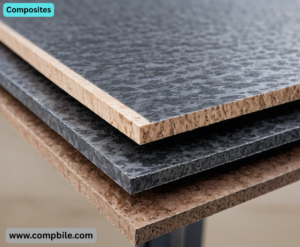
Composites
Fiber-Reinforced Polymers:
- Carbon Fiber: Used in aerospace (aircraft parts), high-performance sports cars, and sporting goods (tennis rackets, fishing rods, bicycles) for its high strength and low weight.
- Fiberglass: Used in boat hulls, car parts, bathtubs, and swimming pools.
- Reinforced Concrete: Concrete (a ceramic composite) is strong under compression but weak under tension. Embedding steel rebar creates a material that is strong under both forces, forming the basis of modern construction.
- Plywood: Layers of wood veneer glued together, with the grain of each layer oriented at right angles to the one below. This gives it greater strength and dimensional stability than natural wood.
Semiconductors
These materials have electrical conductivity between that of a conductor (like metal) and an insulator (like ceramic). Their properties can be precisely controlled, making them the foundation of modern electronics.
- Silicon (Si): The most common semiconductor.
- Electronics: The base material for virtually all computer chips, transistors, and integrated circuits (ICs).
- Gallium Arsenide (GaAs): Used in high-speed electronic devices, LEDs, and laser diodes.
Biomaterials
These are materials engineered to interact with biological systems for a medical purpose.
- Medical Implants: Titanium for hip joints, certain polymers for ligaments, and hydrogels for contact lenses.
- Drug Delivery: Biodegradable polymers that can release medication slowly inside the body.
- Tissue Engineering: Scaffolds made from compatible materials that support the growth of new tissue.
Advanced & Engineered Materials
These are materials designed and synthesized to have very specific properties for high-performance applications.
- Nanomaterials: Materials with structural features on the scale of nanometers (billionths of a meter). Their small size gives them unique optical, electrical, and magnetic properties.
- Uses: Sunscreen (using titanium dioxide nanoparticles to block UV light while remaining clear), stain-resistant clothing (nanowhiskers repel water and oil), carbon nanotube composites for stronger, lighter materials, medical diagnostics.
- Shape-Memory Alloys (SMAs): Metals that “remember” their original shape and return to it when heated.
- Uses: Medical: Stents that expand at body temperature. Aerospace: Morphing wing structures. Consumer: Eyeglass frames that return to shape after being bent.
- Metamaterials: Artificially engineered materials with properties not found in naturally occurring materials. Their structure is designed to manipulate waves (like light or sound).
- Uses: “Invisibility” cloaks (theoretically, by bending light around an object), superlenses for advanced microscopy, perfect sound absorption.
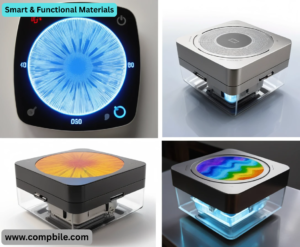
Smart & Functional Materials
These materials have one or more properties that can be significantly changed in a controlled fashion by external stimuli, such as stress, temperature, moisture, pH, electric or magnetic fields.
- Uses Of Materials Piezoelectric Materials: Generate an electric charge when subjected to mechanical stress (and vice-versa).
- Uses: Sensors: Microphones, accelerometers in your phone. Actuators: Inkjet printer heads, precise motors. Energy Harvesting: Generating electricity from footsteps in floors or sidewalks.
- Thermochromic Materials: Change color in response to temperature changes.
- Uses: Mood rings, thermometers for aquariums, baby spoons that change color if food is too hot, mugs that reveal patterns when filled with a hot drink.
- Electroluminescent Materials: Emit light in response to an electric current.
- Uses: Backlights for watches and instrument panels, flexible displays, safety and emergency lighting.
- Self-Healing Polymers: A new class of materials that can automatically repair damage to themselves.
- Uses: Consumer Products: Scratch-healing coatings for cars and phones. Infrastructure: Self-healing concrete that seals micro-cracks, preventing corrosion of rebar and extending the structure’s life.
Example: A bicycle frame needs to be:
- Strong and Stiff (Mechanical) to support the rider.
- Low Density (Mechanical) to be lightweight.
- Fatigue Resistant (Mechanical) to withstand repeated stress cycles.
- Corrosion Resistant (Chemical) for use in all weather.
- Affordable and Weldable (Economic/Manufacturing).
- This is why aluminum alloys are so popular—they offer the best balance of these properties for the price.
The Future of Materials
The field is moving towards increasingly sophisticated and sustainable solutions:
- Biodegradable Polymers: Moving beyond petroleum-based plastics to materials that can safely decompose, reducing plastic pollution (e.g., PLA from corn starch for packaging).
- Materials Informatics: Using artificial intelligence and massive databases to discover new materials with desired properties without costly trial-and-error experiments.
- Advanced Energy Materials: Developing better materials for renewable energy, such as:
- Perovskites for highly efficient and cheaper solar cells.
- Solid-state electrolytes for safer, higher-capacity batteries.
- Biomimicry: Designing new materials inspired by nature. Examples include:
- Self-cleaning surfaces inspired by the lotus leaf.
- Strong, lightweight structures inspired by bone or coral.