
Effective communication Of course. Effective communication is the lifeblood of human connection, both personally and professionally. It’s not just about speaking clearly; it’s about ensuring your message is understood as you intended and that you understand others in return. Here is a comprehensive breakdown of effective communication, from its core components to practical tips.
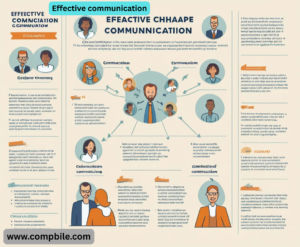
What is Effective Communication?
- Effective communication is a two-way process of sharing and understanding information, thoughts, feelings, and ideas between a sender and a receiver. The ultimate goal is not just to transmit a message, but to have it received, decoded, and understood as it was meant to be.
- A simple model is: Sender -> Message -> Channel -> Receiver -> Feedback
- Effectiveness is measured at the “Feedback” stage. If the feedback shows misunderstanding, the communication was not effective.
The 7 Pillars of Effective Communication
Often remembered by the acronym CREDIBL, these are the key components:
- Clear: The message is easy to understand, free from jargon and ambiguity.
- Relevant: The information is pertinent and valuable to the audience.
- Empathetic: The communicator considers and acknowledges the feelings and perspective of the receiver.
- Direct: The message is concise and to the point, without being unnecessarily blunt.
- Interactive: It encourages a two-way dialogue and invites feedback.
- Believable: The communicator is credible, trustworthy, and authentic.
- Listening: This is the most critical part. It involves active listening to fully comprehend the other person.
Key Types of Communication
Effective communication encompasses several channels:
- Verbal: The words you choose. This includes tone of voice, pitch, and pace.
- Non-Verbal: Your body language, facial expressions, eye contact, posture, and gestures. This often speaks louder than words.
- Written: Emails, reports, texts, and letters. Clarity and structure are paramount here, as tone can be easily misconstrued.
- Visual: The use of images, graphs, charts, and videos to support or convey a message.
Major Barriers to Effective Communication
Understanding what blocks communication is as important as knowing what enables it.
- Psychological: Prejudice, bias, stress, anger, ego, and lack of trust.
- Physical: Noise, distance, distractions, and technical glitches.
- Cultural & Language: Differences in language, accents, cultural norms, and slang.
- Perceptual: Different viewpoints, experiences, and assumptions that lead people to interpret the same message differently.
- Emotional: Strong emotions like fear, anger, or sadness can prevent someone from listening or expressing themselves clearly.
How to Improve: A Practical Guide
Master the Art of Active Listening
- This is not just waiting for your turn to talk.
- Focus Fully: Put away your phone. Make eye contact.
- Show You’re Listening: Nod, use small verbal cues like “I see,” or “Go on.”
- Paraphrase and Reflect: “So, if I’m understanding you correctly, you’re feeling frustrated because…”
- Withhold Judgment: Don’t interrupt with your solution or opinion. Let them finish.
Be Clear and Concise
- Know Your Goal: What is the single most important thing you want them to know, feel, or do?
- Use Simple Language: Avoid jargon and acronyms unless you’re sure the audience understands them.
- Structure Your Message: Use frameworks like PREP for opinions:
- Point: State your main point. (“I think we should postpone the launch.”)
- Reason: Give your primary reason. (“Because the beta test revealed critical bugs.”)
- Example: Provide evidence. (“For example, 30% of users experienced a crash on login.”)
- Point: Restate your main point. (“Therefore, postponing is the safest choice.”)
Pay Attention to Non-Verbal Cues
- Align Your Body and Words: Smile when giving positive news. Maintain an open posture (uncrossed arms).
- Observe Others: Are their arms crossed? Are they avoiding eye contact? This might signal discomfort or disagreement.
- Mind Your Tone: The same sentence (“That’s a great idea”) can sound sincere or deeply sarcastic based on your tone.
Develop Empathy
- Practice Perspective-Taking: Before responding, try to see the situation from the other person’s point of view. What are their pressures, goals, and fears?
- Acknowledge Feelings: “It sounds like you’re really passionate about this project,” or “I can see why that would be upsetting.” This validates their experience without necessarily agreeing with them.
Solicit and Provide Constructive Feedback
- Ask Open-Ended Questions: Instead of “Did you understand?”, ask “What are your main takeaways from this?”
- Be Specific: “The data on slide 3 was very clear and helped me understand the problem,” is more useful than “Good presentation.”
- Focus on Behavior, Not the Person: “The report was missing the financial analysis,” not “You are careless.”
Advanced Skills & Nuances
Mastering Meta-Communication
- This is “communication about communication.” It’s a higher-level skill used to prevent or resolve misunderstandings by discussing the process itself.
- When to use it: When you sense tension, confusion, or a repeated pattern of miscommunication.
Examples:
- “I feel like we might be talking past each other. Can we take a step back?”
- “The way I’m explaining this doesn’t seem to be working. Would a diagram help?”
- “It seems like this topic is making us both defensive. Can we agree to focus on the problem, not each other?”
Strategic Use of Questions
- Move beyond simple open-ended questions to guide the conversation more effectively.
- Clarifying Questions: Unpack assumptions and vague language.
- “Can you give me an example of what ‘good’ looks like in this context?”
- Probing Questions: Drill down into the root cause.
- “What led you to that conclusion?”
- “What’s the underlying challenge behind this symptom?”
- Strategic Questions: Shift perspective to the future and possibilities.
- “If we had no constraints, what would the ideal solution be?”
- “What’s one small step we could take this week that would have the biggest impact?“
Framing and Reframing
- How you present a message (the “frame”) drastically alters how it’s received. Reframing is the skill of shifting that perspective.
Problem Frame vs. Outcome Frame:
- Problem: “We’re 50% behind on our sales target.” (Focuses on failure)
- Outcome: “To hit our annual target, we need to focus on achieving X in the next quarter.” (Focuses on solution)
- Reframing a Complaint: When someone says, “This process is a nightmare,” you can reframe it by saying, “It sounds like you’re looking for a way to make this process more efficient and less frustrating. What’s the biggest bottleneck?”
Managing Emotional Regulation
- You cannot communicate effectively when you are hijacked by anger, anxiety, or fear. Your ability to manage your own emotions is a prerequisite for skilled communication.
Techniques:
- The Pause: Before reacting, take a breath. A simple, “Let me think about that for a second,” gives you back control.
- Name the Emotion: Acknowledge it internally. “I am feeling angry right now.” This creates distance between you and the reaction.
- Separate Intent from Impact: Remember that someone might not have intended to cause the negative impact you’re feeling.
Frameworks for Specific Scenarios
For Giving Difficult Feedback: The SBI Model (Situation-Behavior-Impact)
- This model removes judgment and focuses on observable facts.
- Situation: Describe the specific, observable context. “In yesterday’s team meeting at 10 AM…”
- Behavior: Describe the specific, observable behavior—do not label or judge. “…when you interrupted Sarah while she was presenting her data…”
- Impact: Describe the impact the behavior had on you, the team, or the project. “…it caused her to lose her train of thought, and I felt it shut down the open discussion we were trying to have.”
- Follow-up with a question: “What was going on from your perspective?”
For Conflict Resolution: The Interest-Based Relational (IBR) Approach
- This focuses on underlying needs and interests rather than fixed positions.
- Separate the People from the Problem: Attack the issue, not each other.
Focus on Interests, Not Positions:
- Position: “I want the window open.” vs. “I want the window closed.”
- Interest: “I need fresh air.” vs. “I’m allergic to the draft.”
- Invent Options for Mutual Gain: Once interests are clear, brainstorm.
- Use Objective Criteria: Base the solution on fair standards. “According to the office comfort policy, the temperature should be 72 degrees.”
For Persuasion and Influence: Ethos, Pathos, Logos
A classic rhetorical framework for building a compelling case.
- Ethos (Credibility): Establish your trustworthiness and expertise.
- Pathos (Emotional Connection): Appeal to emotions and values. “This change will not only improve efficiency but also significantly reduce stress for our team.”
- Logos (Logical Argument): Use data, facts, and reasoning. “The data shows a 15% increase in engagement when we use this method. Here is the chart…”