
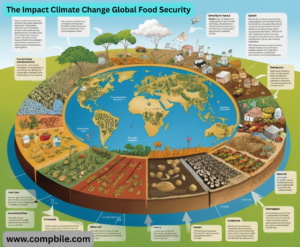
The Impact Climate Change Global Food Security Of course. The impact of climate change on global food security is one of the most critical and complex challenges of our time. It represents a direct threat to the stability of the world’s food systems and the well-being of billions of people. Here is a detailed breakdown of the impact, broken down into key areas.
Executive Summary
- Climate change is no longer a future threat to food security; it is a present-day reality. It acts as a threat multiplier, exacerbating existing vulnerabilities in the global food system. Its impacts are felt across the entire food chain—from crop yields and livestock health to fishing and food distribution—ultimately undermining all four pillars of food security: Availability, Access, Utilization, and Stability.
Direct Impacts on Agricultural Production (Availability)
This is the most visible and widely studied impact.
Changing Temperature and Precipitation Patterns:
- Heat Stress: Many staple crops like wheat, corn, and rice have critical temperature thresholds. Prolonged heat during flowering or grain-filling can lead to significant yield losses. For example, for every 1°C increase in global mean temperature, global yields of wheat are projected to decline by about 6%, rice by 3.2%, and maize by 7.4%.
- Shifting Growing Seasons: Warmer temperatures are altering the length and timing of growing seasons. In some cooler regions, this may initially benefit agriculture, but in most tropical and subtropical regions, it leads to shorter growing periods and reduced productivity.
- Drought and Water Scarcity: Increased evaporation and changing rainfall patterns are leading to more frequent and severe droughts. This reduces water availability for irrigation, which is crucial for 40% of the world’s food production.
Extreme Weather Events:
- Floods: Heavy, intense rainfall can waterlog and destroy crops, erode topsoil (a non-renewable resource on human timescales), and damage critical infrastructure like storage facilities and roads.
- Hurricanes and Cyclones: These can cause catastrophic damage to crops, livestock, and fisheries in a matter of hours.
- Wildfires: Increasing in frequency and intensity, wildfires destroy farmland, pasture, and forests, and can alter regional weather patterns.
Pests and Diseases:
- Warmer temperatures allow pests (e.g., fall armyworm, locusts) and plant diseases to expand their range to new regions and survive through milder winters, leading to greater crop losses.
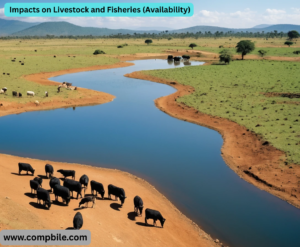
Impacts on Livestock and Fisheries (Availability)
Livestock:
- Heat Stress: Reduces animal fertility, milk production, and meat quality, and can increase mortality rates.
- Feed and Fodder Scarcity: Drought reduces the availability of pasture and water, leading to poorer animal health and lower productivity.
- Spread of Animal Diseases: Similar to crops, warmer temperatures facilitate the spread of vector-borne diseases like bluetongue and Rift Valley fever.
Fisheries and Aquaculture:
- Ocean Warming and Acidification: Warmer waters cause fish stocks to migrate toward the poles, disrupting local fishing industries. Acidification harms shellfish and corals, which are the foundation of vital marine ecosystems.
- Coral Bleaching: Destroys critical nursery habitats for many fish species.
- Extreme Events: Storms damage aquaculture infrastructure and coastal fishing communities.
Impacts on Food Access and Utilization
Climate change doesn’t just affect how much food is produced; it affects people’s ability to get and use it.
- Rising Food Prices: Reduced supply and crop failures lead to price volatility and spikes. This disproportionately affects the poor, who spend a large portion of their income on food.
- Loss of Livelihoods: Smallholder farmers, pastoralists, and fishers—who contribute a significant portion of the world’s food—are often the most vulnerable. A single drought or flood can wipe out their entire livelihood, destroying their ability to both produce and purchase food.
- Nutritional Quality: Elevated CO2 levels can reduce the concentration of essential nutrients like protein, zinc, and iron in staple crops like rice and wheat, leading to “hidden hunger” even if caloric intake remains the same.
- Water and Sanitation: Flooding can contaminate freshwater sources, leading to waterborne diseases that prevent the body from absorbing nutrients properly (impacting utilization).
Impacts on Stability
Climate change increases the volatility of the entire food system.
- Supply Chain Disruption: Extreme weather events can damage transportation networks (roads, ports), storage facilities, and processing centers, preventing food from reaching markets.
- Increased Volatility: The increasing frequency of climate shocks makes it difficult to predict harvests, leading to greater price instability and market uncertainty.
- Risk of Conflict: Resource scarcity, such as competition for water and fertile land, can exacerbate social tensions and lead to displacement and conflict, further disrupting food production and access.
Unequal Impact: A Deepening of Inequalities
The impacts of climate change on food security are not felt equally. The regions and populations that are most vulnerable are often those that have contributed the least to the problem.
- Tropical and Subtropical Regions: Low-income countries, particularly in Sub-Saharan Africa and South Asia, are projected to suffer the greatest crop yield losses because they are already in hot climates.
- Small-Scale Farmers and Indigenous Communities: These groups often rely directly on climate-sensitive natural resources and have limited capacity to adapt.
- Women and Children: They often bear the brunt of food insecurity, facing higher risks of malnutrition, which can have lifelong consequences for health and development.
Potential Solutions and Adaptation Strategies
Addressing this crisis requires a two-pronged approach: mitigation (reducing greenhouse gas emissions from agriculture) and adaptation (adjusting to the changes already underway).
- Climate-Smart Agriculture (CSA): Practices designed to sustainably increase productivity, enhance resilience, and reduce emissions.
- Examples: Drought- and heat-tolerant crop varieties, improved water management (drip irrigation), agroforestry, soil conservation, and integrated pest management.
- Diversification: Encouraging farmers to diversify their crops and livestock to spread risk.
- Improved Infrastructure: Investing in storage, transportation, and early warning systems for extreme weather.
- Social Safety Nets: Programs like crop insurance and cash transfers can protect vulnerable households from climate shocks.
- Reducing Food Loss and Waste: Approximately one-third of all food produced is lost or wasted. Reducing this can significantly lessen the pressure on production systems.
- Supporting Smallholder Farmers: Providing them with access to credit, information, and resilient technologies is crucial for global food security.
Impacts on Livestock and Fisheries (Availability)
The initial impacts on production trigger a domino effect throughout the entire socio-economic system:
The Livelihoods-Price Feedback Loop:
- The Impact Climate Change Global Food Security A smallholder farmer’s crop fails due to drought.
- This means less food to sell (loss of income) and less food for their own family.
- Simultaneously, regional crop failures cause local food prices to spike.
- The farmer now has less money and faces higher prices, a double shock that devastates their food access and plunges them deeper into poverty, reducing their capacity to invest in resilient practices for the next season.
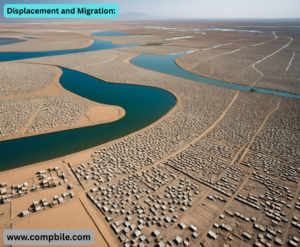
Displacement and Migration:
- When land becomes unproductive due to desertification, salinization from sea-level rise, or recurrent drought, people are forced to move.
- This climate-induced migration often shifts populations from rural to urban areas, increasing pressure on urban food systems and potentially leading to social unrest.
- Cross-border migration can strain regional relations and create new geopolitical tensions over resources.
The Mental Health Toll:
- The constant stress and uncertainty of farming in a changing climate lead to anxiety, depression, and a sense of helplessness among agricultural communities.
- The loss of ancestral lands and traditional ways of life represents a profound cultural and psychological impact that is often overlooked.
Climate Change as the Ultimate “Threat Multiplier”
This term, frequently used by military and security experts, is crucial here. Climate change doesn’t operate in a vacuum; it intensifies pre-existing problems:
- Poverty: It pushes those on the edge into chronic hunger and makes it nearly impossible for them to climb out.
- Weak Governance: In countries with corrupt or ineffective institutions, climate impacts are worse because there is no safety net, no strategic grain reserve, and no effective early warning system.
- Social Inequality: It disproportionately harms those who are already marginalized—women, indigenous communities, and the landless poor—deepening societal divides.
- Conflict: While not a direct cause, climate change can be a potent catalyst for conflict. For example, the drought in Syria (2007-2010), considered its worst in modern history, led to mass rural-to-urban migration, economic hardship, and social unrest, creating conditions ripe for the subsequent civil war.
Emerging and Complex Challenges
The CO2-Nutrition Quality Paradox:
- This is a silent and insidious threat. Studies at the Free-Air CO2 Enrichment (FACE) facilities have shown that elevated atmospheric CO2 levels (the very driver of warming) reduce the concentrations of protein, zinc, iron, and B vitamins in major staple crops like rice and wheat.
- This means that even if we manage to maintain yields, the food could be less nutritious, potentially putting hundreds of millions at risk of nutrient deficiencies.
Compound and Cascading Events:
- The real danger is no longer just a single drought or flood. It’s the combination of events.
- Example: A heatwave reduces yields, followed by heavy rains that prevent harvesting and cause fungal infestations in the remaining crop, which is then hit by a new, invasive pest that has thrived in the warmer winter. The system has no time to recover between shocks.
The Threat to “Agricultural Breadbaskets”:
- The world relies on a few key regions (like the US Midwest, the Brazilian Cerrado, the Indo-Gangetic Plain, and the Ukrainian Steppe) for a large portion of its staple grain exports.
- Climate models project that many of these breadbaskets are highly vulnerable to concurrent extreme events. A simultaneous drought in North America and a heatwave in Eastern Europe could trigger a global food price crisis, unlike anything we’ve seen before.
Loss of Agrobiodiversity:
- As climate zones shift, the specific local knowledge and crop varieties (landraces) developed over centuries may become maladapted. This loss of genetic diversity reduces the raw material breeders need to develop future climate-resilient crops.
Deeper Look at Adaptation and the Path Forward
The solutions must be as multi-faceted as the problem.
Transformative Adaptation vs. Incremental Adjustment:
- The Impact Climate Change Global Food Security Incremental: Using a bit more irrigation to deal with drought. This often just manages the problem in the short term.
- Transformative: Fundamentally changing the system. Examples include:
- Shifting Agricultural Frontiers: As some regions become too hot/dry, new ones may open up (e.g., parts of Canada, Siberia), which brings its own massive environmental and social challenges.
- Radical Dietary Shifts: Accelerating the transition to plant-based proteins and alternative foods (e.g., lab-grown meat, insects) which have a far lower climate and land footprint.
- Agroecological Redesign: Moving beyond single practices to whole-system redesigns that mimic nature, creating closed-loop systems that are inherently more resilient.
The Digital and Genetic Frontier:
- Precision Agriculture: Using satellites, drones, and sensors to apply water and fertilizers with extreme efficiency, minimizing waste and environmental impact.
- Next-Generation Climate Services: Hyper-local weather forecasting and crop disease alerts delivered directly to farmers’ mobile phones.
- Advanced Breeding: Using gene editing (like CRISPR) and genomic selection to rapidly develop crops that are drought-tolerant, heat-resistant, and more nutritious.
The Critical Role of Policy and Finance:
- Reforming Subsidies: Trillions of dollars in global agricultural subsidies currently promote unsustainable practices (e.g., monocultures, overuse of fertilizers). Redirecting this funding towards regenerative and resilient practices is essential.
- Carbon Markets for Soil: Creating financial incentives for farmers to adopt practices that sequester carbon in the soil, improving soil health while mitigating climate change.
- International Cooperation: Strengthening mechanisms like the FAO’s Agricultural Market Information System (AMIS) to enhance market transparency and prevent export bans during crises, which exacerbate global price spikes.