

AI Quiz Of course! Here is a quiz about Artificial Intelligence, covering its history, key concepts, and modern applications. The answers are at the bottom.
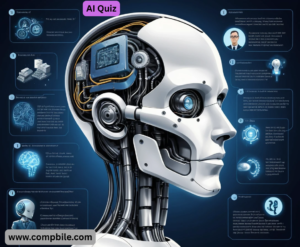
The AI Knowledge Quiz
What is the classic, overarching goal of Artificial Intelligence research?
a) To pass the Turing Test.
- b) To create machines that can sense, reason, think, and act like humans.
c) To automate all human jobs.
d) To build systems that can solve specific, narrow tasks better than humans.
Which of these is considered a major founding event of AI as an academic field?
The invention of the transistor.
- b) The release of the paper “Computing Machinery and Intelligence” by Alan Turing.
c) The Dartmouth Workshop of 1956.
d) The development of the first chatbot, ELIZA.
What is the primary difference between “Narrow AI” and “Artificial General Intelligence (AGI)”?
- a) Narrow AI is open-source, while AGI is proprietary.
b) Narrow AI is faster, while AGI is more accurate.
c) Narrow AI is designed for a specific task, while AGI would have human-like, general cognitive abilities.
d) Narrow AI uses less power, while AGI requires quantum computing.
n Machine Learning, what is the term for the process where an algorithm improves its performance by being exposed to
labeled data?
- a) Unsupervised Learning
b) Reinforcement Learning
c) Supervised Learning
d) Deep Learning - What is the core function of a neural network in deep learning?
a) To store vast amounts of data.
- b) To create a graphical interface for users.
c) To find patterns in data through interconnected layers of nodes (neurons).
d) To connect to the internet and gather real-time information.
Which of these is a key ethical concern often associated with AI?
- a) AI will become too expensive to maintain.
b) AI might make decisions that are biased or unfair.
c) AI requires too much electricity to be practical.
d) AI can only be programmed in specialized languages.
What is the main purpose of a Generative AI model, like GPT or DALL-E?
a) To analyze and classify existing data
- b) To control the movements of a robotic arm.
c) To generate new, original content (text, images, etc.) based on its training.
d) To encrypt data for security purposes.
In the context of self-driving cars, what does “Computer Vision” primarily allow the car to do?
a) Calculate the most fuel-efficient route.
- b) Understand and interpret visual information from the world, like identifying pedestrians and traffic signs.
c) Communicate with other vehicles on the road.
d) Play music and entertainment for the passengers.
What is a “Large Language Model” (LLM)?
- a) A massive database of pre-written sentences and paragraphs.
b) An AI system that translates between hundreds of languages simultaneously.
c) A neural network trained on vast amounts of text data to understand and generate human language.
d) A model that predicts the physical properties of new materials.
Answers
- b) To create machines that can sense, reason, think, and act like humans. (This is the broad, long-term ambition of the field.)
- c) The Dartmouth Workshop of 1956. (This summer conference, led by John McCarthy, who coined the term “Artificial Intelligence,” is widely considered the birthplace of AI as a formal discipline.)
- c) Narrow AI is designed for a specific task, while AGI would have human-like, general cognitive abilities. (All AI in use today, from chess engines to recommendation algorithms, is Narrow AI. AGI remains a theoretical goal.)
- c) Supervised Learning. (The “supervision” comes from the labeled data, which acts as an answer key for the algorithm to learn from.)
- c) To find patterns in data through interconnected layers of nodes (neurons). (These networks are loosely inspired by the human brain and are excellent at recognizing complex patterns.)
- b) AI might make decisions that are biased or unfair. (This is a major concern because AI systems can learn and amplify biases present in their training data.)
- c) To generate new, original content (text, images, etc.) based on its training. (Unlike analytical models, generative models
create new data that is similar to their training data.)
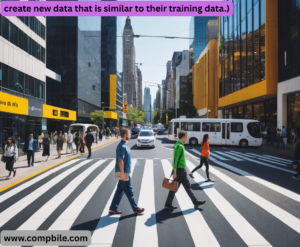
Understand and interpret visual information from the world, like identifying pedestrians and traffic signs. (Computer Vision gives machines the ability to “see” and understand their visual environment.) c) A neural network trained on vast amounts of text data to understand and generate human language. (Models like GPT-4 and Gemini are examples of LLMs, which power modern chatbots and writing assistants.)
AI Quiz: Level 2
What is the fundamental process called where an AI model becomes progressively better at a task by adjusting its internal
parameters based on error?
a) Data Mining
b) Training (or Optimization)
c) Compiling
d) Indexing
- Which type of machine learning is best suited for teaching a computer to play a complex game like Go or StarCraft, where it learns by trial and error through rewards and penalties?
a) Supervised Learning
b) Unsupervised Learning
c) Reinforcement Learning
d) Transfer Learning - The “Transformer” architecture, which powers most modern LLMs, is renowned for what key mechanism that allows it to
weigh the importance of different words in a sequence?
a) Backpropagation
b) Attention
c) Convolution
d) Random Forests
- What does the term “Hallucination” most commonly refer to in the context of Large Language Models?
a) The model needing to sleep and dream.
- b) The model generating plausible but incorrect or nonsensical information.
c) A bug that causes the model’s code to crash.
d) The visual effects seen when training a model for too long.
What is the primary goal of “Computer Vision”?
a) To give computers human-like eyes.
- b) To enable computers to gain a high-level understanding of digital images and videos.
c) To improve the screen resolution of monitors.
d) To create virtual reality headsets.
The technique of “Prompt Engineering” is best described as:
- a) The engineering discipline of building faster computer processors.
b) The process of designing and refining the input text (the prompt) to get better desired outputs from an AI model.
c) The maintenance of the AI’s training database.
d) A method for fixing bugs in the AI’s source code.
What is a “Diffusion Model” primarily used for?
a) Spreading information across a social network.
- b) Generating high-quality images by gradually adding and then removing noise from data.
c) Diagnosing diseases in medical imaging.
d) Speeding up the training time of neural networks.
- Which of these is a significant challenge in developing safe and aligned AGI (Artificial General Intelligence)?
a) The “Value Alignment Problem,” or ensuring the AGI’s goals and behaviors are aligned with human values.
b) The high cost of computer memory.
c) A lack of programming languages suitable for AGI.
d) The inability to create powerful enough batteries for robots.