

Descriptive Language and Imagery Let’s break down descriptive language and imagery, exploring what they are, how they work, and how you can use them.

What Are Descriptive Language and Imagery?
- At its core, descriptive language is the use of words and phrases to create a vivid picture, evoke emotions, and engage the reader’s senses. It’s the opposite of simply stating facts.
- Imagery is the product of that description—the mental pictures, sensations, and experiences that form in the reader’s mind. It’s the “movie” that plays in your head when you read a powerful piece of writing.
Think of it this way:
- Descriptive Language is the toolkit (the words, the techniques).
- Imagery is the result (the experience for the reader).
The Five (or More) Senses: The Foundation of Imagery
- Effective imagery appeals to more than just sight. To truly immerse a reader, you need to engage all their senses.
- Visual Imagery (Sight): The most common type. It describes what something looks like.
- Example: “The emerald-green vines coiled tightly around the crumbling, sun-bleached bricks of the old well.”
- Auditory Imagery (Sound): Describes what something sounds like.
- Example: “A distant, rhythmic thumping echoed through the forest, followed by the faint, melodic tinkle of wind chimes.”
- Olfactory Imagery (Smell): Describes scents and odors.
- Example: “The attic was filled with the sweet, dusty scent of old paper and the sharp tang of mothballs.”
Gustatory Imagery (Taste): Describes flavors.
- Descriptive Language and Imagery Example: “The soup was a comforting, savory broth, with a surprising hint of smoky paprika on the finish.”
- Tactile Imagery (Touch): Describes how something feels physically.
- Example: “She ran her fingers over the smooth, cool surface of the polished marble, careful to avoid its jagged, sharp edge.”
- Kinesthetic Imagery (Movement): Describes a sense of motion or tension in the body’s muscles and joints.
- Example: “He felt the burn in his thighs as he pushed against the steep incline.”
- Organic Imagery (Internal Sensations): Describes internal, physical feelings like hunger, thirst, fatigue, or a racing heart.
- Example: “A cold knot of dread tightened in her stomach.”
Key Tools and Techniques of Descriptive Language
- Writers use specific literary devices to build their imagery.
- Simile: A comparison using “like” or “as.”
- Example: “The new, artificial grass felt as stiff as a Brillo pad.”
- Example: “The moon was a sliver of a fingernail in the twilight sky.”
- Personification: Giving human qualities to non-human things.
- Onomatopoeia: Words that imitate the sound they describe.
- Example: “The buzz of the saw was followed by the loud crack of the timber.”
- Hyperbole: Intentional exaggeration for effect.
- Specificity & Precise Verbs/Nouns: Using the exact right word is the most powerful tool. Don’t say “tree,” say “gnarled oak.” Don’t say “walked,” say “shuffled,” “strode,” or “trudged.”
Putting It All Together: From Bland to Vivid
- Let’s see how descriptive language transforms a simple sentence.
Bland Statement:
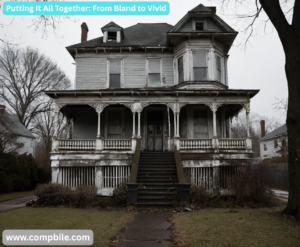
- “The house was old.”
- Descriptive & Imagery-Rich:
- “The Victorian house slumped on its foundation like a tired old man, its paint peeling in long, grey curls (Visual/Tactile). A faint, sour smell of damp rot (Olfactory) drifted from the porch, and the constant, rhythmic groan of a loose shutter (Auditory) was the only sound breaking the evening silence. As I touched the banister, it shuddered, sending splinters into my palm (Tactile/Kinesthetic).”
- The second version doesn’t just tell you the house is old; it makes you see, hear, smell, and feel its age.
Why Is It So Important?
- Creates Vivid Settings: It transports the reader directly into the world of the story.
- Reveals Character: How a character perceives the world (what they notice, how they describe it) tells us about their personality and mood.
- Evokes Emotion: Describing a place as “warm and bathed in golden light” creates a very different feeling than “cold and shrouded in long, grasping shadows.”
- Makes Writing Memorable: Powerful imagery sticks with the reader long after they’ve finished the page.
A Final Tip for Using Descriptive Language
- Show, Don’t Tell. This is the golden rule.
- Telling: “George was scared.”
- Showing: “A cold sweat beaded on George’s forehead. His heart hammered against his ribs like a trapped bird, and his breath hitched in his throat.”
Advanced Applications: What Else Can Imagery Do?
- Descriptive Language and Imagery Imagery isn’t just for setting a scene. Master writers use it to:
Foreshadowing and Creating Mood:
- Imagery can set a psychological tone that hints at future events.
- Example: “The celebration was in full swing, but outside, long shadows clawed their way up the manor walls, and a sudden chill snuffed out the candles on the windowsill.” (This visual and tactile imagery creates a sense of dread, foreshadowing an intrusion.)
Symbolism and Theme:
- Recurring images can become symbols that reinforce the story’s central themes.
- Example: In a story about entrapment, you might repeatedly use imagery of cages, tangled threads, locked doors, and murky water. This creates a cohesive thematic tapestry.
Character Development:
- The imagery a narrator or character uses reveals their inner world—their biases, desires, and mental state.
- A joyful character might see: “The sun danced on the waves, and the clouds were pillows of whipped cream.”
- A depressed character in the exact same scene might see:** “The sun glared mercilessly on the water, and the clouds were a heavy, suffocating blanket.”
Controlling Pacing:
- The density and type of imagery can affect how quickly a reader moves through a scene.
- Fast Pacing (Action): Sparse, sharp imagery. “A flash of steel. A searing pain in his side. The metallic taste of blood.”
- Slow Pacing (Reflection): Dense, detailed imagery. “The light of the dying fire played across her face, deepening the hollows of her cheeks and glinting in the single tear that traced a path through the dust there.”
Nuanced Techniques: The Subtle Art of Description
The “Iceberg” Principle (Hemingway):
- Suggest the description rather than spelling it all out. Trust the reader to connect the dots. Describe a few key sensory details and let the reader’s mind build the rest of the picture.
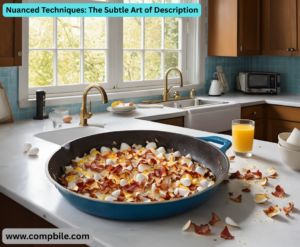
- Instead of: “The kitchen was a mess from a huge breakfast. There were dirty pans, splattered grease, and eggshells everywhere.”
- Try: “The air in the kitchen was thick with the smell of bacon and burnt coffee. A tower of eggshells teetered in the sink.”
Figurative Language Beyond Simile and Metaphor:
- Synecdoche: Using a part to represent the whole.
- Example: “The city was a sea of suits and ties hurrying to work.” (The clothing represents the businesspeople.)
- Synesthesia: Blending senses; describing one sense in terms of another.
- Example: “She had a bright, citrusy laugh.” (Mixing sound and taste/sight.)
- Example: “The paint was a loud, shrieking red.” (Mixing sight and sound.)
Leveraging Verbs and Nouns over Adjectives and Adverbs:
- While adjectives and adverbs have their place, powerful nouns and verbs do the heavy lifting.
- Weak: “He walked quickly through the very dark forest.”
- Strong: “He stalked through the blackened forest.” or “He picked his way through the gloom.”
Potential Pitfalls and How to Avoid Them
Even the most beautiful description can backfire if overused or misapplied.
The “Purple Prose” Problem:
- Descriptive Language and Imagery This is writing that is overly ornate, melodramatic, and self-consciously “literary,” to the point where it distracts from the story.
- Overwritten: “Her azure orbs, twin sapphire pools of liquid anguish, spilled crystalline tears that traced sorrowful paths down her alabaster cheeks.”
- Revised & More Powerful: “Tears welled in her blue eyes and streaked through the grime on her face.”
Description That Halts the Action:
- A long, static paragraph of description in the middle of a chase scene will kill the momentum. Weave description into the action.
- Halting: “He ran for the door. The door was made of old, dark oak with iron hinges that were rusted. The handle was cold and heavy in his hand…”
- Weaved: “He flung himself at the old oak door, his hand closing around the cold, heavy iron of the handle.”
Irrelevant Detail:
- Every description should serve a purpose—to set a mood, develop character, or advance the plot. If it doesn’t, cut it.
- Ask yourself: Does the reader need to know the exact pattern on the irrelevant side character’s wallpaper? Probably not.
Cliché:
- Using overused imagery deadens your writing. “White as snow,” “red as a rose,” “dark as night.” Strive for fresh, original comparisons.
- Cliché: “Her cheeks were red as apples.”
- Fresh: “Her cheeks were the mottled red of a bruised pomegranate.”