
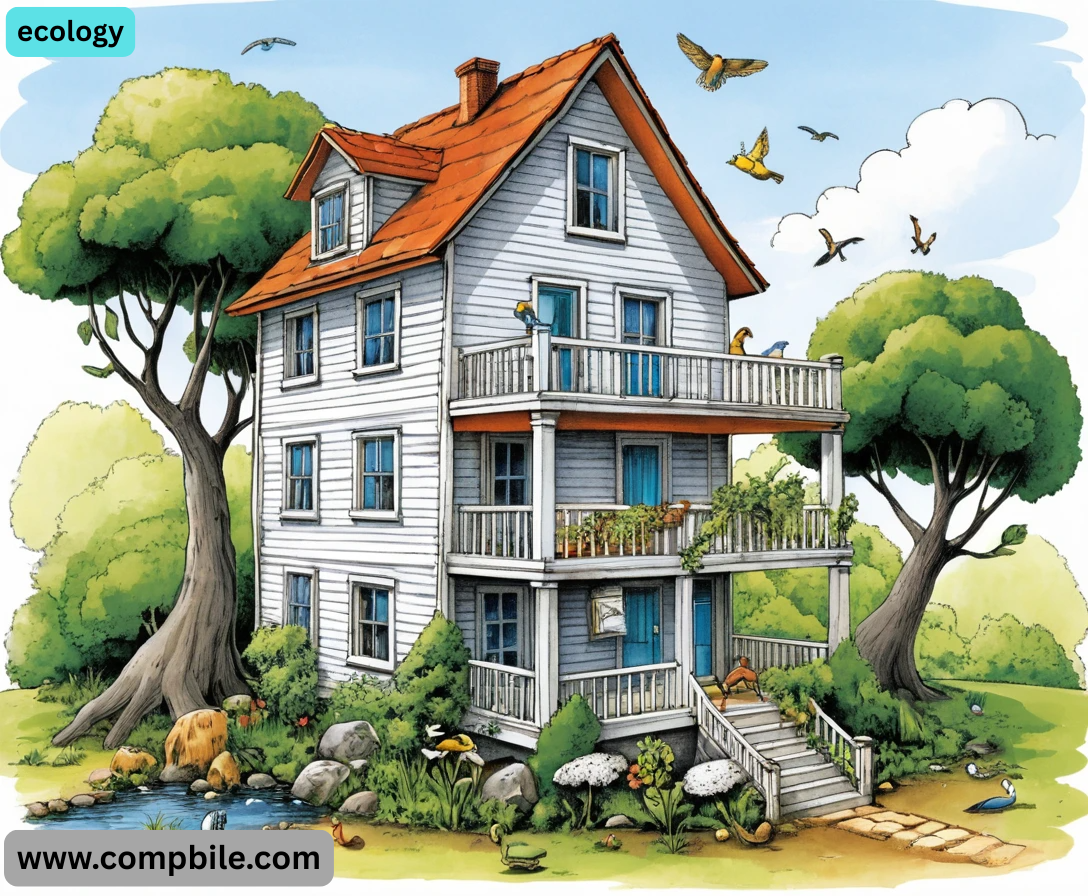
Ecology Ecology is the scientific study of the interactions between organisms and their environment, and how these interactions determine the distribution and abundance of organisms. The term comes from the Greek words oikos (meaning “house” or “place to live”) and logos (meaning “study of”). Essentially, it is the study of the “house” in which all life lives.
- It is important to distinguish ecology from environmentalism. Ecology is a science, based on observation and experimentation. Environmentalism is a social and political movement that uses the knowledge gained from ecological science to advocate for the protection of the natural world.
Key Levels of Organization in Ecology
Ecologists study nature at multiple levels, from the individual to the planet:
- Organism: How an individual’s structure, physiology, and behavior meet the challenges of its environment.
- Ecologists study factors that affect population size and growth (e.g., birth rates, death rates, immigration, emigration).
- Community: All the different populations of various species that live together in a defined area. Ecologists study predator-prey relationships, competition, and symbiosis.
- Ecosystem: All the living things (communities) in an area, along with the non-living (abiotic) parts of their environment (e.g., soil, water, air, sunlight, nutrients). Energy flow and nutrient cycling are key focuses.
- Biome: A large geographical area with a distinct climate and specific types of plant and animal communities (e.g., tropical rainforests, deserts, tundras).
- Biosphere: The sum of all Earth’s ecosystems—the zone of life on Earth, from the depths of the ocean to the upper atmosphere.
Core Concepts in Ecology
Biotic and Abiotic Factors
- Biotic Factors: The living components of the environment (e.g., plants, animals, bacteria, fungi, and their interactions like predation, competition, and decomposition).
- Abiotic Factors: The non-living chemical and physical components (e.g., temperature, sunlight, water, wind, soil pH, minerals). These factors determine which organisms can survive in a given place.
Energy Flow
- Energy moves through an ecosystem in a one-way stream.
- The Sun: The primary source of energy for most ecosystems.
- Producers (Autotrophs): Mostly plants and algae, they capture solar energy and convert it into chemical energy (food) via photosynthesis.
- Consumers (Heterotrophs): Organisms that rely on other organisms for energy.
- Primary Consumers (Herbivores): Eat producers.
- Secondary Consumers (Carnivores): Eat herbivores.
- Tertiary Consumers: Eat secondary consumers.
- Omnivores: Eat both plants and animals.
- Decomposers (Detritivores): Like fungi and bacteria, they break down dead organic material, returning vital nutrients to the soil.
- This sequence of energy transfer is called a food chain. The interconnected, complex relationships of multiple food chains form a food web. Only about 10% of the energy is transferred from one trophic level to the next (the 10% Rule); the rest is lost as heat.
Nutrient Cycling (Biogeochemical Cycles)
- While energy flows through an ecosystem, nutrients are recycled. Key elements like carbon, nitrogen, phosphorus, and water move through the biotic (living) and abiotic (non-living) parts of the ecosystem in continuous loops.
- The Carbon Cycle: Involves photosynthesis, respiration, decomposition, and combustion (burning fossil fuels).
- The Water Cycle: Involves evaporation, condensation, precipitation, and transpiration (from plants).
- The Nitrogen Cycle: Involves nitrogen fixation by bacteria, decomposition, and nitrification.
Biodiversity
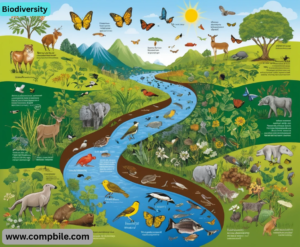
- This refers to the variety of life at all levels: genetic diversity, species diversity, and ecosystem diversity. High biodiversity is crucial for ecosystem resilience (the ability to withstand disturbance) and stability. It provides “ecosystem services” vital to human life, such as clean air and water, pollination of crops, and disease regulation.
Ecological Interaction
- Competition: (-/-) Organisms fighting for the same limited resources (e.g., food, space).
- Predation: (+/-) One organism (predator) kills and eats another (prey).
- Herbivory: (+/-) An animal eats a plant.
- Symbiosis: A close, long-term interaction between two different species.
- Mutualism: (+/+) Both benefit (e.g., bees and flowers).
- Commensalism: (+/0) One benefits, the other is unaffected (e.g., barnacles on a whale).
- Parasitism: (+/-) One benefits (parasite), the other is harmed (host) but not usually killed immediately (e.g., ticks on a dog).
Major Sub-disciplines of Ecology
- Population Ecology: Studies population dynamics and changes.
- Community Ecology: Examines how interactions between species (competition, predation) affect community structure.
- Ecosystem Ecology: Emphasizes energy flow and chemical cycling.
- Landscape Ecology: Focuses on the connections between multiple ecosystems.
- Conservation Ecology: Applies ecological principles to protect and restore biodiversity.
- Global Ecology: Studies the workings of the entire biosphere.
Why is Ecology Important?
Understanding ecology is not just an academic exercise; it is critical for solving pressing global problems:
- Conservation Biology: Protecting endangered species and managing wildlife reserves.
- Natural Resource Management: Sustainable forestry, fisheries, and agriculture.
- Climate Change: Predicting and mitigating the effects of a warming planet on ecosystems.
- Public Health: Understanding the spread of diseases (epidemiology) and the health of our environment.
- Pollution Control: Understanding how pollutants move through and affect ecosystems.
Advanced Concepts & Dynamics
Ecology in Depth
- Ecologists use mathematical models to understand and predict population changes.
Growth Models:
- Exponential Growth: J-shaped curve. Occurs when a population has unlimited resources. Described by the equation dN/dt = rN (where N is population size, *r* is the intrinsic rate of increase).
- Logistic Growth: S-shaped curve. Accounts for limiting resources (like food, space). Growth slows as the population approaches the ecosystem’s carrying capacity (K), the maximum population size the environment can sustain. Described by dN/dt = rN((K-N)/K).
- Life History Strategies: Species evolve different strategies for survival and reproduction.
- R-selected species: High growth rate (*r*), many offspring with low parental care, opportunistic (e.g., bacteria, insects, weeds).
- K-selected species: Lower growth rate, fewer offspring with high parental care, adapted to stable environments near carrying capacity (K) (e.g., elephants, humans, whales).
Regulation:
- Density-Dependent Factors: Effects intensify as population density increases (e.g., competition for food, spread of disease, predation).
- Density-Independent Factors: Effects are unrelated to population density (e.g., natural disasters, weather events, pollution).
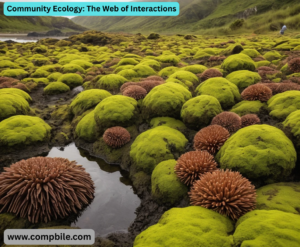
Community Ecology: The Web of Interactions
- Keystone Species: A species with an influence on its community much larger than its abundance would suggest. Their removal causes a dramatic shift in the ecosystem (e.g., sea otters preying on sea urchins, which allows kelp forests to thrive).
- Ecological Succession: The predictable process of change in the species structure of a community over time.
- Primary Succession: Begins in a virtually lifeless area with no soil (e.g., after a volcanic eruption or glacial retreat). Lichens and mosses pioneer the area, leading to soil formation.
- Secondary Succession: Occurs after a disturbance (e.g., fire, hurricane, logging) that destroys a community but leaves the soil intact. Grasses and fast-growing plants are typically first.
- When a change at one trophic level (e.g., an increase in predators) causes a cascade of effects on lower levels (e.g., decrease in herbivores, leading to an increase in producers).
Ecosystem Ecology: The Macro View
- Primary Productivity: The rate at which producers convert solar energy into chemical energy.
- Gross Primary Productivity (GPP): Total amount of energy captured.
- Net Primary Productivity (NPP): The energy remaining after producers use some for their own respiration (NPP = GPP – Respiration). NPP is the energy available to consumers. It varies greatly across biomes (e.g., tropical rainforests have very high NPP; deserts have very low NPP).
- Biogeochemical Cycles: These can be grouped based on their main reservoir:
- Gaseous Cycles: The main reservoir is the atmosphere or ocean (e.g., Carbon, Nitrogen).
- Sedimentary Cycles: The main reservoir is the Earth’s crust (e.g., Phosphorus, Sulfur).
Major Applied Ecological Fields
- Restoration Ecology: The practice of renewing and restoring degraded, damaged, or destroyed ecosystems. Ecologists work to return an area to its natural, historical state (e.g., restoring prairie grasslands or wetlands).
- Landscape Ecology: Studies the ecological patterns and processes across large geographic areas. It focuses on the interactions between patches (e.g., a forest, a field, a lake) and how the structure of a landscape affects its function (e.g., how a highway fragments animal habitats).
- Urban Ecology: The study of ecosystems in the context of human-dominated environments like cities. It examines how species adapt to urban areas and how we can design cities to be more sustainable.
- Disease Ecology: Studies the interactions between pathogens, hosts, and their environment. Crucial for understanding the emergence and spread of infectious diseases like Lyme disease or Zika virus.
Critical Ecological Issues & Challenges
- Climate Change: The overarching crisis affecting all ecological systems. It is altering species distributions (range shifts), phenology (timing of seasonal events like migration and flowering), and threatening specialized species (e.g., polar bears, coral reefs).
- Habitat Loss & Fragmentation: The primary driver of biodiversity loss. Converting land for agriculture, urbanization, and other development breaks continuous habitats into smaller, isolated patches, making populations more vulnerable.
- Invasive Species: Non-native species introduced (often by humans) to a new area where they lack natural predators. They can outcompete native species, alter habitats, and cause economic damage (e.g., zebra mussels in the Great Lakes, kudzu vine in the southeastern US).
- Pollution: The introduction of contaminants into the environment. This includes:
- Chemical Pollution: Pesticides, industrial chemicals, and plastics that can be toxic or disrupt endocrine systems.
- Overexploitation: Harvesting species from the wild at rates faster than they can naturally replenish (e.g., overfishing, poaching, the illegal wildlife trade).
How Ecologists Work: Tools & Methods
- Field Studies & Observation: The classic approach, from counting species in a quadrat to radio-tracking animals.
- Remote Sensing & GIS: Using satellite imagery and Geographic Information Systems to map and analyze ecological data over vast areas and track changes over time (e.g., deforestation rates, ocean chlorophyll levels).
- Modeling: Creating mathematical and computer simulations to predict complex ecological phenomena, such as the spread of wildfires, the impacts of climate change, or population genetics.
Experiments:
- Lab Experiments: Controlled settings to test specific hypotheses.
- Field Experiments: Manipulating conditions in nature (e.g., adding nutrients to a lake, fencing areas to exclude herbivores).
- Long-Term Ecological Research (LTER): Sites funded for decades to collect consistent data, which is vital for understanding slow processes like succession and the effects of gradual climate change.