
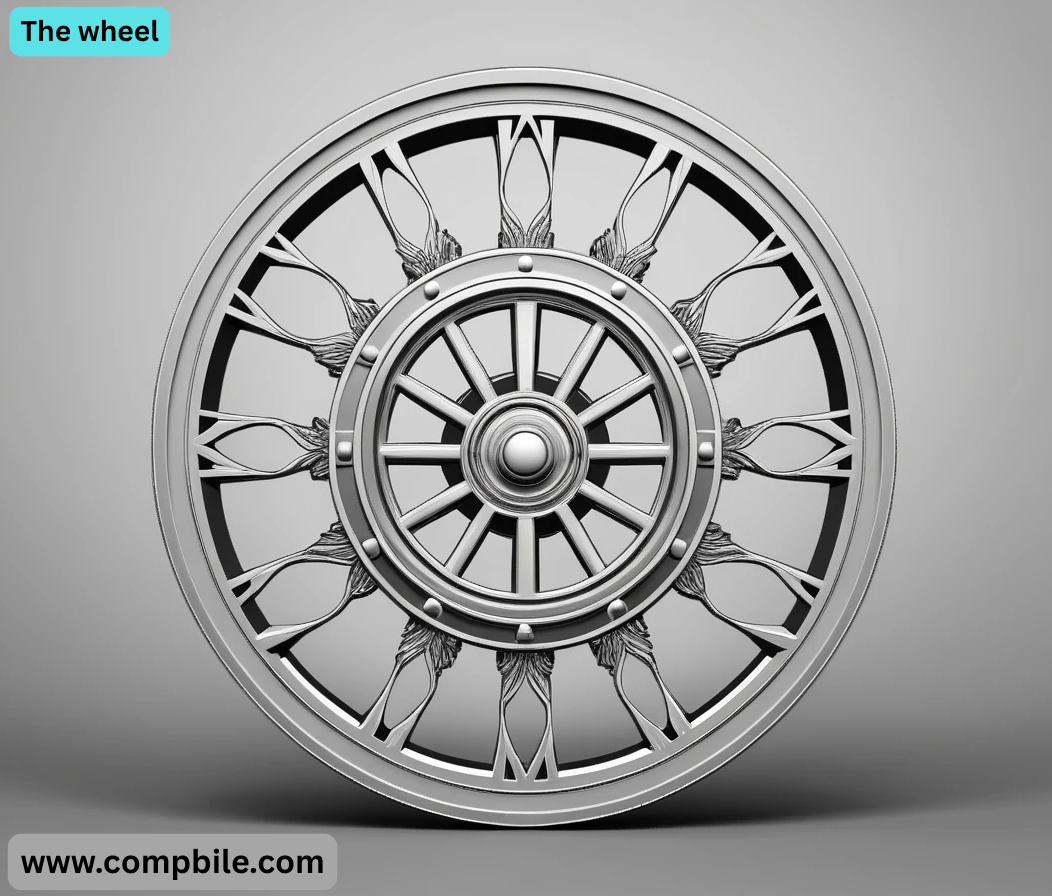
The wheel Of course. The wheel is a deceptively simple yet world-changing invention. Here’s a comprehensive breakdown of the wheel, covering its history, mechanics, why it was so revolutionary, and its modern applications.

The Core Concept and Mechanics
- At its simplest, a wheel reduces friction by facilitating rolling motion. Instead of sliding an object (which creates a lot of friction), rolling it requires significantly less force.
- Function: The primary function of a wheel is to enable efficient movement or transportation. It can also be used for transmission of power (e.g., gears, water wheels), steering, and supporting loads.
Key Components:
- Wheel: The circular object.
- Axle: The rod or shaft on which the wheel rotates. The axle is fixed to the vehicle or object, and the wheel rotates around it.
Why the Invention Was So Revolutionary (And Surprisingly Late)
- The Problem: The concept of a rolling cylinder (like a log) was known, but creating a fixed axle that a wheel could rotate around was a complex engineering challenge. It required sophisticated woodworking tools to carve the axle and a precisely sized hole in the wheel.
The Timeline:
- ~3500 BC: The earliest known wheels, used as potter’s wheels, appear in Mesopotamia (modern-day Iraq).
- ~3300 BC: The first evidence of wheeled vehicles (wagons) emerges in Europe and Mesopotamia. This was a monumental leap.
Why So Late? It required a settled society with:
- Advanced Carpentry: To shape strong, round wheels and a smooth axle.
- Metal Tools: Sharp copper chisels and gouges were needed to work the wood precisely.
- Flat Terrain: Early wheels were useless in mountainous, forested, or marshy terrain. They required cleared paths or roads, which themselves are a major infrastructure project.
Evolution and Improvements
The basic wheel has been refined over millennia:
- Spoked Wheels: Invented around 2000 BC, spokes made wheels much lighter and faster, revolutionizing chariot warfare and transportation.
- Iron Rims: The Celts and other ancient cultures began adding metal rims (tyres) around 1000 BC to strengthen wheels and reduce wear.
- The Pneumatic Tyre: Invented by John Boyd Dunlop in 1888, the air-filled rubber tyre provided crucial cushioning and grip, making modern high-speed travel and automobiles possible.
- Modern Materials: Today, wheels are made from advanced alloys, composites, and plastics for specific applications (e.g., lightweight magnesium alloy car wheels, carbon fiber bicycle wheels).

Modern Applications
- The wheel is everywhere in modern life, far beyond just vehicles.
- Transportation: Cars, trucks, bicycles, airplanes, skateboards, shopping carts.
- Industry and Machinery: Gears, pulleys, turbines, cranes, conveyor belts, drills, and lathes. Almost every machine has a rotating component based on the wheel.
- Technology: Hard drives, gyroscopes, drones, and robotics all rely on the principle of the rotating wheel.
A Fascinating “What If?”
- The wheel is a classic example of independent invention.
- While it spread from Mesopotamia to Europe and Asia,
- it was never invented in the pre-Columbian Americas
- (apart from on children’s toys found in Mexico).
The reasons are debated but likely include:
- A lack of large draft animals to pull wheeled vehicles.
- Terrain dominated by steep mountains and dense rainforests, where sleds or porters were more practical.
- The immense focus and resources required to develop the technology without a known model.
The Physics: Why Rolling is Easier Than Sliding
This is the fundamental genius of the wheel. It all comes down to friction.
- Sliding Friction: When you drag an object, you must overcome the maximum static friction across the entire surface area in contact with the ground. This requires a lot of force.
- Rolling Friction: A wheel converts this high sliding friction into a much lower rolling friction. The point of the wheel in contact with the ground is momentarily at rest (it doesn’t slide), and the wheel pivots around this point. The energy lost is primarily due to the deformation of the wheel and the ground (imagine a heavy truck tire squashing slightly on the asphalt).
- This is why you need an engine
- to move a car, but only a tiny fraction
- especially at high speeds.
The Axle: The Wheel’s More Important Partner
- The is useless without the axle. The interface between the and the axle is a critical engineering challenge.
- Friction (Again!):
- To be efficient, the friction at the axle hub
- (the hole in the where the axle sits)
- must be minimized.
- If the friction is too high, the will drag and not turn properly.
Solutions Through History:
- Lubrication: Ancient cultures used animal fat or grease to reduce friction at the axle.
- Bearings: The invention of the bearing was a quantum leap. Simple bearings (like in old carts) used smooth, hard wood or stone. Later, roller bearings (using small cylinders) and ball bearings (using spheres) distributed the load and reduced friction dramatically, enabling modern machinery.
The “Wheel” That Wasn’t: A Case of Mistaken Identity
- The key distinction is between a solid, rotating disc and a true wheel-and-axle system.
- The Sledge and Roller Method: Long before the wheel, Egyptians and others moved massive stone blocks by placing them on sledges and pulling them over a path of rolling logs. This is not a wheel. The logs are rollers, not fixed wheels on an axle.
- The Potter’s Wheel: This was likely the first application of the rotating principle. It demonstrates the understanding of rotation but lacks the fixed axle and hub of a transportation wheel.

The Wheel’s Greatest Enemy: Terrain
- The wheel’s limitation is a profound reason for its absence in many cultures. It is a technology of prepared surfaces.
Ineffective on:
- Soft Ground:
- Sand, mud, or snow cause
- The Alternative: In these terrains, pack animals (like llamas in the Andes) or human porters were far more efficient and adaptable. This is a major reason why advanced civilizations in the Andes and Mesoamerica never developed the wheel for transport—their geography made it a solution in search of a problem.
The Wheel as a Symbol
- Beyond its physical utility, the carries immense symbolic weight across cultures.
- The Wheel of Fortune (Rota Fortunae): In medieval and Roman philosophy, it represents the capricious nature of fate—sometimes you’re at the top, sometimes at the bottom, and the wheel is always turning.
- The Dharmachakra: In Buddhism, the “of Dharma” represents the Noble Eightfold Path and the endless cycle of birth, death, and rebirth (samsara) that one seeks to escape through enlightenment. It is a central symbol on the Indian flag.
- Progress and Innovation: In the modern world, the is a universal symbol for movement, progress, and technological advancement (“reinventing the,” “wheels of industry,” “set the wheels in motion”).