History and Culture Of course! “History and Culture” is a vast and intertwined subject that forms the very foundation of human civilization. It’s the story of who we are, where we come from, and the shared meanings we create. Let’s break down this fascinating relationship.
The Inseparable Bond: History and Culture
Think of them as two sides of the same coin:
- History is the chronological record of past events—the wars, migrations, inventions, leaders, and social changes. It’s the narrative and the timeline.
- Culture is the living expression of a people—their beliefs, values, art, language, customs, laws, and daily practices. It’s the “software of the mind” that guides how people live and interpret the world.
The Relationship:
- History Shapes Culture: Major historical events profoundly influence culture.
- Example: The Black Death in 14th century Europe killed a huge portion of the population. This trauma led to a cultural shift in art (the morbid Danse Macabre), challenged the authority of the Church, and altered labor dynamics, eventually contributing to the Renaissance.
- Example: The experiences of colonialism, the transatlantic slave trade, and subsequent independence movements have deeply shaped the cultural identities, languages, political systems, and social structures of nations across Africa, the Americas, and Asia.
- Culture Drives History: The values and beliefs of a culture can be the engine for historical change.
- Example: The cultural and intellectual movement known as the Enlightenment in 18th-century Europe, with its emphasis on reason, liberty, and individual rights, directly fueled the American and French Revolutions, changing the course of world history.
- Example: The Silk Road was not just a trade route for goods; it was a massive conduit for cultural exchange. Buddhism spread from India to China, papermaking technology moved from China to the West, and artistic techniques were shared across continents.
Key Concepts in Understanding History and Culture
Cultural Diffusion
This is how cultural elements—ideas, styles, religions, technologies, languages—spread from one culture to another. This happens through:
- Trade: The Silk Road is the classic example.
- Migration: The movement of people brings their culture with them (e.g., the Irish diaspora bringing their culture to America).
- Conquest and Colonialism: Often forced, leading to the imposition of one culture upon another.
- Mass Media and the Internet: The modern, rapid form of cultural diffusion.
Cultural Hearth
A “hearth” is a point of origin, a source for major cultural ideas and innovations. Ancient cultural hearths include:
- Mesopotamia (The Fertile Crescent): Cradle of writing (cuneiform), law codes (Hammurabi’s Code), and the wheel.
- The Indus Valley: Advanced urban planning and sanitation.
- Ancient Egypt: Monumental architecture, a unique writing system (hieroglyphs), and complex religious beliefs about the afterlife.
- The Yellow River Valley (China): The foundation of Chinese civilization, with early forms of writing and bureaucracy.
Syncretism
- This occurs when different cultures blend together to form a new, hybrid culture. It’s a common result of cultural diffusion.
- Example: In the Americas, Catholicism brought by Spanish colonizers blended with indigenous African and Native American beliefs to create new religions like Vodou in Haiti and Santería in Cuba.
- Example: The English language is a syncretic language, heavily influenced by Latin, French, and Germanic roots.
Major Eras and Their Cultural Outputs
The Classical Era (c. 500 BCE – 500 CE):
- Greece: Democracy, philosophy (Socrates, Plato, Aristotle), theater, and the Olympic ideal.
- Rome: Engineering (aqueducts, roads), law, and the spread of Latin, which would evolve into the Romance languages.
- Han China: Confucianism as a state philosophy, the expansion of the Silk Road.
- India: The Mauryan Empire and the spread of Buddhism under Ashoka.]
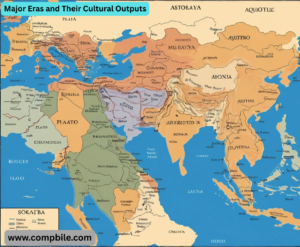
The Middle Ages (c. 500 – 1400):
- Europe: The dominance of the Catholic Church, feudalism, Gothic architecture (cathedrals), and chivalry.
- The Islamic Golden Age: A center of learning, preserving Greek texts and making advances in mathematics, astronomy, and medicine.
- Tang & Song China: A cultural golden age with advancements in poetry, painting, and the invention of gunpowder and movable type.
The Renaissance and Enlightenment (c. 1400 – 1800):
- A “rebirth” of classical learning in Europe, leading to humanism, incredible art (Da Vinci, Michelangelo), and scientific inquiry.
- The Enlightenment shifted authority from the Church and monarchy to reason and the individual, setting the stage for modern democracy.
The Modern Era (c. 1800 – Present):
- Industrial Revolution: Transformed society from agrarian to urban, creating new social classes and cultural tensions.
- Nationalism: The idea that people with a shared culture and history should have their own state, leading to the unification of countries like Germany and Italy.
- Globalization: The accelerated exchange of culture on a global scale, leading to both homogenization (e.g., global brands) and a renewed interest in preserving local cultural identities.
Why Studying History and Culture is Crucial Today
- Fosters Empathy and Understanding: By learning about other cultures and their histories, we break down stereotypes and build bridges of understanding in an increasingly interconnected world.
- Provides Context for Current Events: You cannot understand modern conflicts, political movements, or international relations without understanding their historical and cultural roots.
- Preserves Heritage: It helps us appreciate and protect the diverse cultural traditions, languages, and monuments that are humanity’s shared inheritance.
- Helps Us Understand Ourselves: Our personal identities are shaped by the historical and cultural forces that influenced our families and communities.
Key Lenses for Analyzing History and Culture
Historians and anthropologists often use these frameworks to interpret the past and its cultural products:
The Great Man vs. Social History
- Great Man Theory: The old idea that history is shaped by the actions of “great” leaders, heroes, and geniuses (e.g., Alexander the Great, Napoleon, Einstein).
- Social History (“History from Below”): Focuses on the lives of ordinary people—their work, family structures, leisure, and struggles. This lens asks: What was life like for a peasant, a factory worker, or a merchant’s wife? It emphasizes collective movements and social forces over individual leaders.
Material vs. Intellectual History
- Material History: Examines how physical conditions—geography, climate, technology, economy, and disease—shape societies. For example, how the invention of the plow revolutionized agriculture or how the Little Ice Age affected European history.
- Intellectual History: Traces the evolution of ideas, philosophies, ideologies, and scientific thought. It explores how concepts like “democracy,” “rights,” or “the scientific method” emerged and changed over time.
The Center vs. The Periphery
- This lens challenges the traditional narrative that focuses only on powerful “centers” (e.g., Rome, London, Washington D.C.).
- It asks: What was happening on the periphery—in the colonies, the rural areas, the borderlands?
- This approach has been crucial for decolonizing history, revealing how events at the periphery were often crucial to developments at the center and giving voice to marginalized and indigenous perspectives.
The “Tools” of Culture: Elements that Define a Society
Culture is manifested through tangible and intangible elements:
- Language: More than just words; it shapes how we perceive reality. The vocabulary and structure of a language reflect what is important to a culture (e.g., the many Inuit words for snow, the precise German terms for concepts).
- Social Norms and Rituals: From handshakes to bowing, from Thanksgiving dinner to Japanese tea ceremonies. These are the “scripts” for social behavior.
- Arts and Aesthetics: Literature, music, visual arts, dance, and cuisine. These are the most visible exports of a culture, expressing its values, fears, and joys.
- Institutions: Family structures, educational systems, governments, and religious organizations. These are the structures that perpetuate culture across generations.
- Mythology and Folklore: Stories, legends, and folktales (from King Arthur to Anansi the Spider) that encode a culture’s moral values and explain its origins.
Major Debates and Challenges
The “Great Books” Canon vs. Cultural Relativism
- The Canon: The traditional list of “great” works of literature and philosophy, predominantly from Western, male, and elite sources. Proponents argue they represent the highest achievements of human thought.
- Cultural Relativism: The anthropological principle that a culture should be understood on its own terms, not judged by the standards of another. This has led to expanding the “canon” to include works by diverse voices (women, people of color, non-Western authors) and recognizing different forms of cultural expression as equally valuable.
Presentism
- The danger of interpreting the past through the values and lenses of the present. For example, judging a medieval king by modern democratic standards is ahistorical. Historians strive for historical empathy—understanding the context and worldviews of people in their own time, even when we disagree with them.
Cultural Appropriation vs. Cultural Appreciation
This is a major modern debate stemming from cultural diffusion.
- Appreciation: Engaging with another culture with respect, context, and a desire to learn. It often involves permission, credit, and reciprocity.
- Appropriation: Taking elements from a minority culture without understanding or respect, often while that culture is being oppressed or marginalized. The harm comes from the power imbalance, stripping cultural symbols of their meaning and history (e.g., wearing a Native American headdress as a fashion accessory).
Case Study in Depth: The Renaissance
Let’s apply these concepts to a specific era:
- History (The Events): The fall of Constantinople (1453), the invention of the printing press (c. 1440), the Age of Exploration, the Black Death a century prior.
- Culture (The Output): Humanist philosophy, realistic painting using linear perspective, magnificent sculpture and architecture, secular literature.
The Interconnection:
- The fall of Constantinople sent Greek scholars and classical texts to Italy, fueling the rediscovery of classical learning (Intellectual History).
- The printing press democratized knowledge, breaking the Church’s monopoly on information and allowing new ideas to spread rapidly (Material History).
- Humanism, a cultural and intellectual movement, shifted focus from God to human potential, which in turn drove the Age of Exploration and scientific inquiry (Culture Driving History).
- Wealth from trade and banking (Medici family) provided the patronage that allowed artists like Michelangelo and Leonardo da Vinci to flourish (Material History shaping Culture).