

Climate change Of course. Climate change is one of the most critical and complex issues facing our planet. Here is a comprehensive overview covering what it is, its causes, effects, and potential solutions.
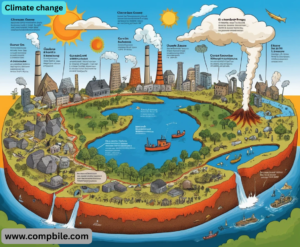
What is Climate Change?
- Climate change refers to significant, long-term shifts in the patterns of weather and average temperatures on Earth. While Earth’s climate has changed throughout its history, the current changes are happening at an unprecedented rate, largely due to human activities.
It’s important to distinguish it from weather:
- Weather is short-term (minutes to months) conditions in the atmosphere (e.g., hot today, rainy tomorrow).
The Primary Cause: The Greenhouse Effect
The main driver of current climate change is the enhanced greenhouse effect.
- Natural Greenhouse Effect: Gases like Carbon Dioxide (CO₂), Methane (CH₄), and Nitrous Oxide (N₂O) naturally exist in the atmosphere. They trap some of the sun’s heat, like a blanket, keeping Earth warm enough for life to exist.
- Enhanced Greenhouse Effect: Human activities have drastically increased the concentration of these greenhouse gases (GHGs). This “thicker blanket” traps too much heat, causing the planet to warm.
Key Human Activities Causing Climate Change
- The burning of fossil fuels (coal, oil, and natural gas) for energy is the dominant cause, accounting for over 75% of global GHG emissions.
- Energy Production: Burning coal and gas for electricity and heat.
- Transportation: Using gasoline and diesel for cars, trucks, ships, and planes.
- Industry: Emissions from chemical reactions to produce goods (e.g., cement, steel, plastics) and from burning fuel for power.
Agriculture & Deforestation:
- Livestock (cows) produce large amounts of methane.
- Deforestation removes trees that absorb CO₂ from the atmosphere.
- Agricultural practices release nitrous oxide from soils.
Observed and Projected Effects
- The consequences of a warming planet are widespread and intensifying.
- Rising Global Temperatures: The past decade has been the warmest on record.
- Melting Ice and Glaciers: Polar ice caps and glaciers are melting at an alarming rate, contributing to sea-level rise.
- Rising Sea Levels: Caused by thermal expansion (water expanding as it warms) and melting ice. This threatens coastal cities and islands.

More Frequent and Intense Extreme Weather Events:
- Heatwaves: More common, longer, and hotter.
- Droughts and Wildfires: Increased risk and severity, especially in arid regions.
- Heavy Rainfall and Flooding: A warmer atmosphere holds more moisture, leading to more intense storms.
- Stronger Hurricanes and Cyclones: Warmer ocean waters provide more energy for storms.
- Ocean Acidification: The ocean absorbs about 30% of the CO₂ we emit, making it more acidic. This harms marine life, especially shellfish and coral reefs.
- Loss of Biodiversity: Rapid climate change is too fast for many species to adapt, leading to habitat loss and increased extinction risks.
- Impacts on Human Society: Food and water scarcity, displacement of people (climate refugees), damage to infrastructure, and increased health risks.
Solutions: Mitigation and Adaptation
- Addressing climate change requires a two-pronged approach:
Mitigation (Tackling the Cause)
- The goal is to reduce the flow of GHG emissions into the atmosphere.
- Transition to Renewable Energy: Rapidly shift from fossil fuels to solar, wind, geothermal, and hydropower.
- Improve Energy Efficiency: Use less energy in buildings, transportation, and industry.
- Sustainable Transportation: Promote electric vehicles, public transit, biking, and walking.
- Protect and Restore Forests: Forests are crucial “carbon sinks.”
- Sustainable Agriculture: Changing farming practices to reduce emissions and store carbon in soil.
- Technological Innovation: Investing in carbon capture and storage (CCS) and green hydrogen.
Adaptation (Coping with the Effects)
- We must also adapt to the changes that are already inevitable.
- Building Sea Walls and Defenses to protect against rising seas.
- Developing Drought-Resistant Crops.
- Improving Water Storage and Conservation.
- Strengthening Early Warning Systems for extreme weather.
- Creating Climate-Resilient Infrastructure.
Global Action and Agreements
- The Paris Agreement (2015): A landmark international treaty where nearly every country agreed to limit global warming to well below 2°C, preferably to 1.5°C, compared to pre-industrial levels. Countries submit national plans (NDCs) to cut emissions.
- The IPCC (Intergovernmental Panel on Climate Change): The UN body for assessing the science related to climate change. Its reports are the gold standard for policymakers.
The Challenge and The Urgency
- The scientific consensus is overwhelming: climate change is real, it’s human-caused, and it’s an urgent threat. The 1.5°C target is critical to avoid the most catastrophic impacts. Every fraction of a degree of warming matters.
The “Why It’s So Complicated”: Systems and Feedback Loops
- Climate change isn’t a simple, linear problem. The Earth’s climate is a complex system of systems, and it’s full of feedback loops that can accelerate or dampen warming.
Amplifying (Positive) Feedback Loops (The Dangerous Ones):
- Ice-Albedo Feedback: Ice and snow are white and reflect sunlight. As they melt, they reveal darker land or ocean beneath, which absorbs more heat, leading to more melting.
- Water Vapor Feedback: Warmer air holds more water vapor, which is itself a potent greenhouse gas, trapping more heat and causing further warming.
- Permafrost Thaw: Warming temperatures thaw Arctic permafrost, releasing vast stores of frozen methane and CO₂, which then cause more warming.
- Forest Dieback: Droughts and heat stress can kill forests, turning carbon sinks (absorbers) into carbon sources (emitters).
Stabilizing (Negative) Feedback Loops:
- Plant Growth: Higher CO₂ levels can, in some conditions, fertilize plant growth, leading to more CO₂ absorption (known as CO₂ fertilization). However, this effect is often limited by nutrients and water and may not keep pace with emissions.
- The concern is that we may cross tipping points—irreversible thresholds in the climate system. Once crossed, they could trigger cascading effects, like the collapse of the Greenland ice sheet or the shutdown of major ocean currents like the Atlantic Meridional Overturning Circulation (AMOC).
The Social, Economic, and Political Dimensions
- This is where the challenge becomes deeply human.
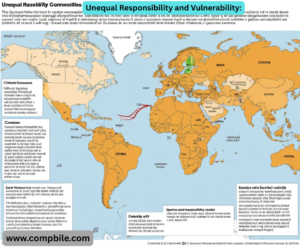
Unequal Responsibility and Vulnerability:
- Historical Responsibility: Developed nations (e.g., the US, EU) are responsible for the majority of historical emissions that are currently in the atmosphere.
- Current Emissions: Large emerging economies (e.g., China, India) are now the largest annual emitters, though their per capita emissions are often still lower than those in developed nations.
- Disproportionate Impact: The poorest nations and communities, who have contributed the least to the problem, are often the most vulnerable to its effects due to geographic location and lack of resources to adapt.
- Climate Justice: This is the ethical and political concept that frames climate change as a social and rights issue. It demands that the burdens and benefits of climate action and inaction are shared fairly.
The Economic Debate:
- Cost of Action vs. Cost of Inaction: While transitioning to a green economy requires massive investment, studies consistently show that the cost of inaction—from disaster damage, health impacts, and lost productivity—will be far greater.
- Stranded Assets: Trillions of dollars in fossil fuel reserves on company balance sheets may become unusable if the world acts on climate, creating a potential for major economic disruption and political resistance.
- Disinformation and Skepticism: Despite the overwhelming scientific consensus, organized disinformation campaigns, often funded by vested interests, have sowed public doubt and slowed political action.
The Solutions in More Detail: From Tech to Behavior
Technological Frontiers (The “What Ifs”):
- Carbon Capture, Utilization, and Storage (CCUS): Technology that captures CO₂ emissions from sources like power plants or directly from the air. It’s seen as crucial for “hard-to-abate” sectors (like cement production) but is currently expensive and not yet deployed at scale.
- Next-Generation Nuclear: Advanced fission and (potential future) fusion reactors that offer carbon-free, baseload power with less waste and safety concerns.
- Green Hydrogen: Hydrogen gas produced using renewable electricity (via electrolysis). It can be a clean fuel for shipping, aviation, and heavy industry.
- Geoengineering: Highly controversial and risky proposed “techno-fixes.”
- Solar Radiation Management (SRM): Spraying reflective particles into the stratosphere to block a small percentage of sunlight. It’s cheap and fast-acting but does nothing for ocean acidification and carries massive unknown risks and governance challenges.