

Hall Effect Joystick Of course! Let’s break down everything you need to know about Hall Effect Joysticks.
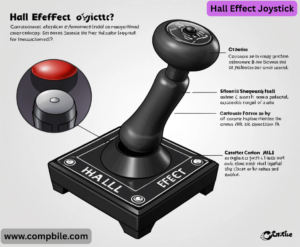
The Core Concept: What is a Hall Effect Joystick?
- A Hall Effect Joystick is a type of joystick that uses the Hall Effect to measure movement, instead of the physical electrical contacts (like potentiometers or carbon pads) found in traditional joysticks.
- The Hall Effect, in a nutshell: When an electric current flows through a conductor (or semiconductor) and a magnetic field is applied perpendicular to this current, a voltage (known as the Hall Voltage) is generated across the conductor.
How a Hall Effect Joystick Works
Inside the joystick, the setup is cleverly simple:
- Magnets: Small, powerful magnets are attached to the base of the joystick’s moving shaft (the gimbal mechanism).
- Hall Effect Sensors: Tiny, stationary sensor chips are placed on the joystick’s PCB, positioned close to where the magnets move.
The Magic of Non-Contact:
- When you move the joystick, the magnets move with the shaft.
- This changes the strength and direction of the magnetic field experienced by the Hall Effect sensors.
- The sensors detect this change and output a corresponding analog voltage signal (typically from 0V to 3.3V or 5V).
- This signal is read by the device’s main processor, which translates it into the joystick’s X and Y axis positions.
The Killer Feature: Elimination of Stick Drift
- Stick drift is the infamous phenomenon where a joystick registers movement even when you’re not touching it. This is the primary reason for controller failure.
- In Potentiometer Joysticks: Stick drift is caused by the gradual wear of the resistive strip. As it wears, it creates inconsistent electrical readings, which the console interprets as phantom inputs.
- In Hall Effect Joysticks: Because there is no physical contact to wear out, the mechanism is inherently immune to this type of wear-induced stick drift. This is their single biggest advantage, especially for gamers.
Advantages and Disadvantages
Advantages:
- Extreme Longevity: Virtually no wear on the sensing mechanism.
- High Precision and Smoothness: No “jitter” in the signal.
- Durability: Resistant to environmental factors like dust and humidity.
- Consistent Performance: Feel and response remain the same throughout the joystick’s life.
Disadvantages:
- Higher Cost: More expensive to produce than potentiometers.
- Magnetic Interference: In theory, they can be affected by very strong external magnetic fields, though this is rarely a practical issue in normal use.
- Complexity: Requires more sophisticated calibration and signal processing.
Technical Deep Dive: Types of Hall Effect Sensing
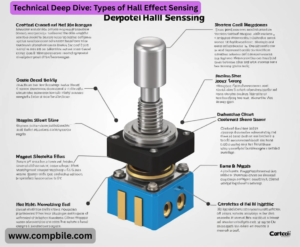
- Not all Hall Effect joysticks are created equal. The way the sensors and magnets are arranged defines the performance and cost. There are two primary methods:
Analog (Linear) Hall Effect Sensors
- This is the most common and precise type used in modern joysticks.
- How it Works: It uses two linear Hall effect sensors per axis. These sensors output a voltage that changes linearly with the strength of the magnetic field.
Setup:
A magnet is mounted on the joystick’s gimbal.
- One sensor measures the X-axis magnetic field component, another measures the Y-axis.
- As you tilt the stick, the magnet’s angle and distance from the sensors change, altering the magnetic field strength on each sensor independently and linearly.
- Advantage: Provides extremely smooth, high-resolution, and true analog output. It’s the “gold standard” for a premium feel.
Digital (Switch) Hall Effect Sensors
This method is simpler but less common for full-range analog sticks.
- How it Works: It uses digital Hall switches that act like a simple on/off button. They only trigger when a magnetic field exceeds a certain threshold.
- Setup: Multiple digital switches are placed at the cardinal directions (e.g., Up, Down, Left, Right).
- Disadvantage: This does not provide a smooth analog range. It’s essentially digital input, telling the device only that the stick is in a general direction, not how far it’s pushed. This is more suited for simple D-pad-like functions than a modern analog stick.
The Anatomy of a Modern Hall Effect Joystick Module
Let’s look at what’s inside a typical module, like the ones from GuliKit or the ALPS modules used in the PS5 DualSense Edge:
- Gimbal Mechanism: The physical plastic/metal structure that holds the stick cap and translates your thumb’s tilt into precise mechanical movement. This part can still wear out over extreme use, but it’s generally very robust.
- Magnets: Mounted on the gimbal. Often rare-earth magnets (like Neodymium) for a strong, consistent field.
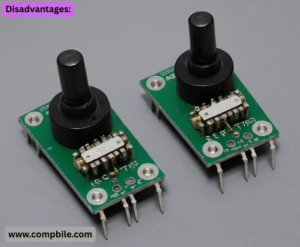
- Sensor PCB: A small circuit board holding the linear Hall effect sensor ICs. This board is fixed and does not move.
- Spring & Mechanism: Provides the centering force—the “snap back” to center when you let go.
- Case & Potentiometer “Dummies”: Many drop-in replacement modules are designed to fit the exact footprint of traditional potentiometer sticks. They often have dummy potentiometer housings that contain the actual Hall sensors and magnets inside.
Beyond Stick Drift: Other Benefits for Gamers
We know they fix drift, but what does that feel like?
- Smoother Inputs: The output signal is inherently cleaner. There’s no “electrical noise” from a scratchy potentiometer, resulting in buttery-smooth camera movements and character control.
- Customization Potential: Without physical wear concerns, developers can more safely offer software-level adjustments that were previously risky, such as:
- Adjustable Dead Zones: You can set the dead zone (the area around the center where no input is registered) to be incredibly small without fear of drift, resulting in a more responsive “1:1” feel.
- Trigger Point Adjustment: Some advanced controllers let you set the exact tilt angle at which an input is considered “full deflection.”
- Consistent Feel Over Time: A traditional potentiometer stick can develop a “grindy” or “loose” feeling as the carbon coating wears away. A Hall effect stick’s physical movement will feel the same on day 1 and day 1,000.
The Market Landscape and Why Now?
The technology has been around for decades, so why is it exploding in the consumer market now?
- The “Stick Drift Crisis”: The high-profile failure of joysticks in popular consoles (most notably the Nintendo Switch Joy-Cons) created massive consumer demand for a permanent solution. This was a catalyst.
- Competitive Gaming: The esports and pro-gaming scene demands the highest level of reliability and precision. Hall Effect joysticks are a tangible upgrade that provides a competitive edge.
- Manufacturing Scale & Cost: As companies like GuliKit and ALPS have ramped up production for the consumer market, the cost of these modules has dropped, making them viable for more products.
- A Key Marketing Differentiator: In a crowded controller market, “Hall Effect Joysticks” and “No Stick Drift” have become powerful selling points that justify a premium price.