
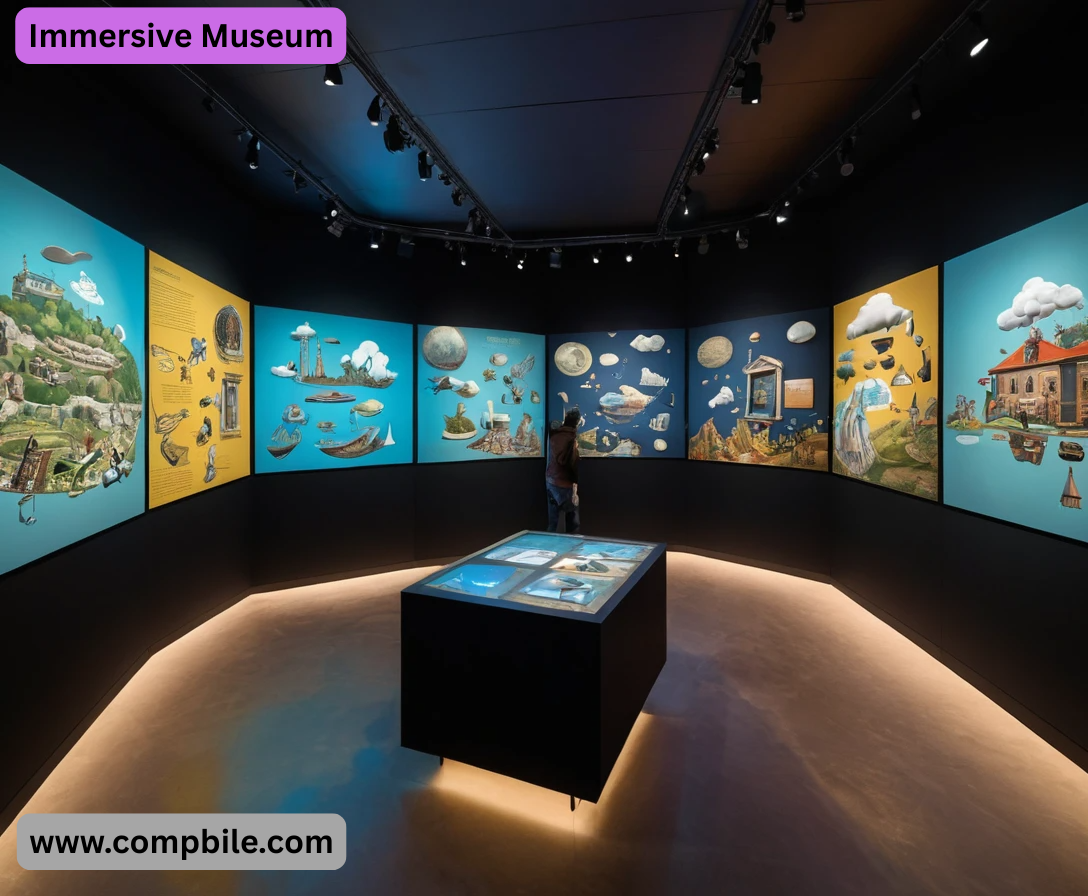
Immersive Museum Of course! The term “Immersive Museum” refers to a modern type of cultural and artistic experience that uses technology and multi-sensory design to surround visitors, placing them inside the art or narrative, rather than having them observe it from a distance.
It’s a shift from the traditional “do not touch” museum model to a “please engage” one.
Key Characteristics of an Immersive Museum:
- Large-Scale Projections: Instead of static paintings on walls, entire rooms become dynamic canvases. High-resolution projectors cover floors, walls, and ceilings with moving, evolving art.
- Multi-Sensory Engagement: It’s not just visual. These experiences often incorporate:
- Sound: Spatially designed soundscapes and music that respond to the visuals and your movement.
- Scent: Diffused smells relevant to the theme (e.g., ocean air, forest pine).
- Touch: Sometimes incorporating physical elements, textures, or even changes in temperature.
- Interactivity: Many installations react to the presence and movements of visitors. Your shadow might cause flowers to bloom, or your steps might create ripples in a projected pool.
- Narrative or Thematic Journey: They are often built around a central theme, like the works of a specific artist (Van Gogh, Klimt), a natural phenomenon (oceans, space), or an original story.
- “Instagrammable” Moments: These spaces are designed to be visually stunning and highly shareable on social media, which is a key part of their marketing and appeal.
Famous Examples and Pioneers:
- teamLab: A Japanese art collective that is arguably the global leader. Their exhibitions, like teamLab Borderless and teamLab Planets in Tokyo, are vast, dreamlike digital worlds where visitors become part of the art.
- Atelier des Lumières (Paris): One of the first and most famous, housed in a former foundry. It set the standard for immersive exhibitions dedicated to great artists like Van Gogh, Monet, and Chagall.
- Van Gogh Experience (Various Locations): This has become a global phenomenon. Exhibitions like “Immersive Van Gogh” and “Van Gogh: The Immersive Experience” use his iconic paintings to create a 360-degree journey through his life and work.
- Artechouse: With locations in NYC, Miami, and D.C., this venue focuses on the intersection of art, science, and technology, often featuring interactive and algorithmic art.
- Meow Wolf: An extreme form of immersion. These are sprawling, narrative-driven walk-through art installations (like “Omega Mart” in Las Vegas) that are part museum, part haunted house, part puzzle, and part fantasy novel.
Pros and Cons of the Immersive Museum Trend:
Pros:
- Accessibility: Makes art and culture engaging for people who might find traditional museums intimidating or boring.
- Emotional Impact: The scale and sensory nature can be breathtaking and emotionally powerful.
- New Audiences: Draws in a younger, more diverse demographic.
- Recontextualization: Allows you to see famous artworks in a new, dynamic light.
Cons:
- “Content” over “Art”: Critics argue it can prioritize spectacle over the subtlety and depth of the original artwork. It’s sometimes called “art-as-entertainment.”
- Crowds and Noise: The popular ones can be very crowded, which can break the immersion.
- Reproduction, Not Original: You are not seeing the original, physical artwork. The “aura” of the authentic piece is lost.
- Commercialization: Some see it as a commodification of high art for a mass market.
A Taxonomy of Immersive Experiences
Not all immersive museums are the same. They fall into several distinct categories:
The Digital Art Sanctuary:
- Focus: Pure, often abstract, digital creation.
- Goal: To evoke wonder and explore the possibilities of digital media.
- Examples: teamLab and Artechouse. The art is native to the digital realm and has no physical original.
The Masterpiece Reimagined:
- Focus: Repurposing the work of classic, often deceased, artists.
- Goal: To make art history accessible and emotionally resonant through a new medium.
- Examples: The Van Gogh Experiences, Klimt Revolution, and shows dedicated to Frida Kahlo or Monet. This is the most common and commercially successful model.
The Narrative Labyrinth:
- Focus: Story. Visitors are characters in an unfolding plot.
- Goal: To create a sense of discovery, adventure, and personal agency.
- Examples: Meow Wolf and Sleep No More (though more theatrical, it’s a direct relative). These often involve puzzle-solving and exploring hidden passages.
The Hybrid Historical Immersion:
- Focus: Using immersion to teach history or science.
- Goal: To create empathy and a visceral understanding of a time, place, or concept.
- Examples: A museum about the Roman Empire that uses VR to let you “walk” through a reconstructed forum, or a science center that projects a galaxy onto its dome.
The Technology Behind the Magic
The immersion is achieved through a sophisticated blend of hardware and software:
- Projection Mapping: The key technology. Software warps and blends projections to fit perfectly onto irregular surfaces—walls, corners, pillars, floors—turning any room into a seamless screen.
- VR/AR Headsets: Used for more personal, guided immersion. VR (Virtual Reality) fully replaces your vision, while AR (Augmented Reality) overlays digital elements onto the real world through a tablet or glasses.
- Spatial Audio: Speakers are placed throughout the environment so that sound can come from specific locations, making a bird’s chirp feel like it’s right above you or a whisper seem to come from the corner.
Sensors and Interactivity:
- Motion Sensors & LiDAR: Detect your presence and movement, allowing the art to react to you.
- Pressure Plates: In the floor to trigger events when stepped on.
- Cameras: For computer vision, allowing more complex interactions like gesture control.
- Generative Art & Real-Time Rendering: The visuals aren’t always pre-recorded videos. Often, they are generated in real-time by software, meaning the animation never loops exactly the same way twice and can respond uniquely to visitors.
The Critical Debate: Deep Dive
- The rise of immersive museums has sparked intense discussion in the art world.
The Case For (The “Democratizers”):
- Democratizing Art: They break down the elitist barriers of traditional institutions. You don’t need an art history degree to feel something in a room swirling with Van Gogh’s stars.
- A Gateway Drug to Culture: For many, this is the entry point. A visitor who loves the immersive Van Gogh might then seek out a real Van Gogh painting at the MoMA or Musée d’Orsay.
- The “Wow” Factor: They create a sense of sublime wonder that a small, framed painting often cannot for a modern audience raised on screens.
- Accessibility: They can be more accessible for people with certain disabilities, offering a visceral experience that doesn’t require reading small placards or seeing fine details.
The Case Against (The “Purists”):
- The “Disneyfication” of Art: Critics argue it reduces profound artistic struggles and techniques into consumable, family-friendly entertainment. It’s art as a theme park ride.
- The Loss of the “Aura”: Philosopher Walter Benjamin coined the term “aura” for the unique, authentic presence of an original work of art—its history, its brushstrokes, its texture. This is completely erased in a digital reproduction.
- Decontextualization: In a immersive Van Gogh show, his dark, tormented struggles are often set to uplifting classical music, sanitizing his life and pain for a pleasant afternoon out.
- The Artist is Absent (and Unpaid): These shows often exploit artists who are no longer under copyright. The entities making millions are production companies, not the artists or their estates.
How to Design an Immersive Museum Experience
If you were to create one, what are the steps?
- Concept and Storyboarding: It all starts with a strong narrative or theme. Every room, transition, and sound should serve the story.
- Space Scouting and Design: The physical architecture is part of the canvas. High ceilings, interesting room shapes, and flow are crucial.
- Content Creation: This involves either digitizing existing artwork at ultra-high resolution or creating original digital art and animations.
- Technical Integration: This is where the magic happens—calibrating projectors, programming sensors, designing the soundscape, and ensuring all elements work in harmony.
- Visitor Journey Mapping: How will people move through the space? Where will they congregate? Where are the “Instagram moments”? How do you avoid bottlenecks?