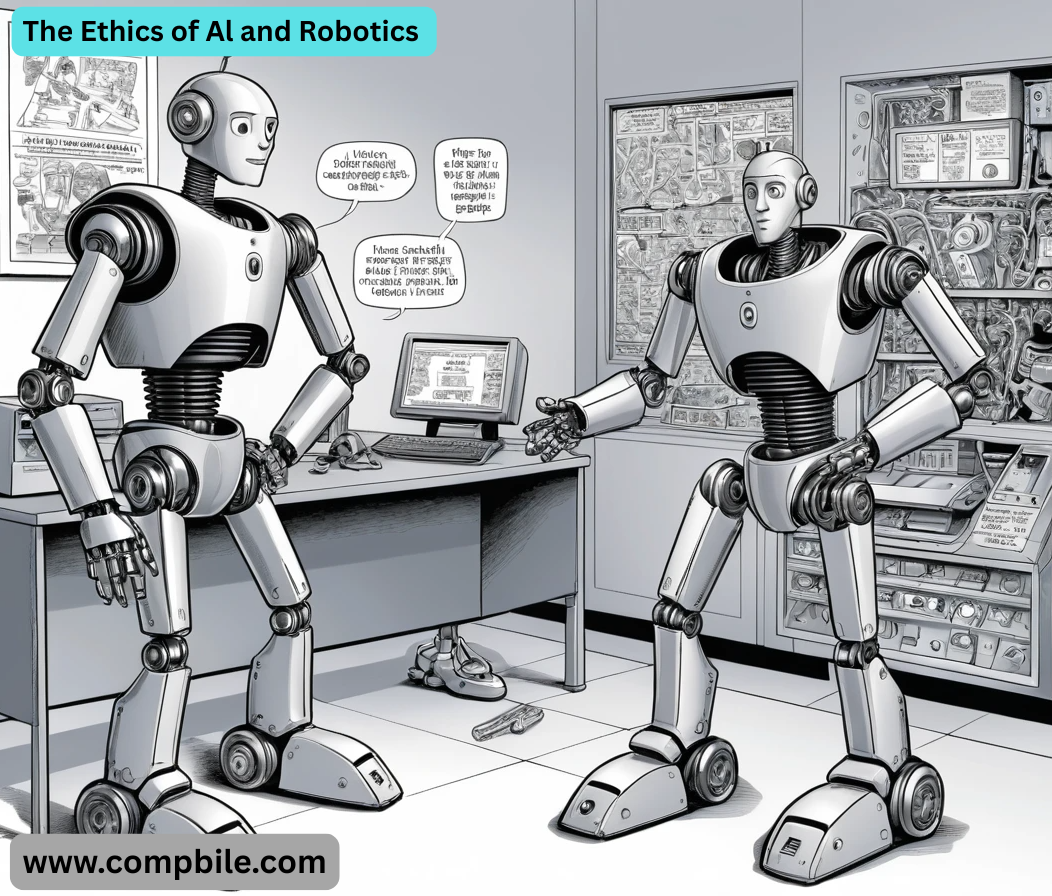
The Ethics of Al and Robotics Of course. The ethics of Artificial Intelligence ( Robotics is a critical and rapidly evolving field of study. It grapples with the moral challenges and responsibilities that arise from creating machines that can act autonomously, make decisions, and interact with the physical world. Here is a comprehensive overview of the key ethical issues, principles, and frameworks surrounding AI and robotics.

Introduction: Why It Matters
- Unlike traditional tools, AI and robotic systems can operate with a significant degree of autonomy, meaning their actions are not entirely predictable or directly controlled by a human operator. This shift from direct human control to machine agency creates a profound ethical gap. We are delegating decisions—some of them with life-altering consequences—to algorithms and machines. The core question is: How do we ensure these technologies are developed and used for the good of humanity, minimizing harm and injustice?
- The ethical considerations can be broadly divided into two overlapping categories: AI Ethics (focused on software, algorithms, and data) and Robot Ethics (focused on embodied systems that interact with the physical world).
Key Ethical Issues & Challenges
Bias and Fairness
- Problem: AI systems learn from data. If that data reflects historical or social biases (e.g., in hiring, policing, or lending), the AI will perpetuate and even amplify these biases. This leads to discriminatory outcomes.
- Example: A recruiting algorithm trained on data from a male-dominated industry might downgrade resumes from women. A facial recognition system trained primarily on one ethnicity performs poorly on others, leading to misidentification.
Transparency and Explainability (The “Black Box” Problem)
- Problem: Many complex AI models, particularly deep learning systems, are opaque.
- Example: If an AI denies a loan application or a medical diagnosis, the individual has a right to an explanation. Without it, there is no path to appeal, learn, or hold anyone accountable.
Accountability and Liability
Problem: When an autonomous system causes harm or makes a catastrophic error, who is responsible?
- The programmer?
- The manufacturer?
- The user/owner?
- The AI itself?
Was it a sensor failure (manufacturer), a flawed algorithm (programmer), improper maintenance (owner), or an unavoidable situation? This creates a “responsibility gap.”
Privacy and Surveillance
- Problem: AI enables mass data collection and analysis on an unprecedented scale. This power can be used for beneficial purposes (e.g., public health) but also for pervasive surveillance, social scoring, and eroding personal privacy.
- Example: Widespread use of facial recognition by governments can create a society where citizens are constantly tracked and their behaviors analyzed, chilling free speech and assembly.
Autonomy and Human Agency
- Problem: As AI systems make more decisions for us (what to watch, what to buy, which route to drive), there is a risk that human skills will atrophy and our own ability to make choices and shape our lives will be diminished.
- Example: Over-reliance on navigation apps may impair our innate sense of direction and ability to navigate. Algorithmic content curation can create “filter bubbles,” limiting our exposure to diverse ideas.
Safety and Security
- Problem: AI systems must be robust, reliable, and safe from manipulation. A flawed or hacked AI can cause immense physical and digital harm.
- Example: A hacker taking control of a connected robotic industrial arm or a swarm of drones. Adversarial attacks could trick an AI vision system in a car into missing a stop sign.
Job Displacement and Economic Inequality
- Problem: Automation through AI and robotics threatens to displace a wide range of jobs, from manufacturing to white-collar analysis. While it may create new jobs, the transition could be painful and exacerbate economic inequality if the benefits are not widely shared.
- Example: Autonomous trucks could displace millions of drivers. AI diagnostic tools could change the role of radiologists.
Robot-Specific Ethics (for embodied systems)
- The Ethics of Al and Robotics Deception & Anthropomorphism: Should we design robots to mimic human emotions and social cues, potentially deceiving users (especially children and the elderly) into forming emotional bonds with machines?
- Lethal Autonomous Weapons (LAWS): The development of “slaughterbots” – robots that can select and engage targets without human intervention – is a paramount concern, raising fears of a new global arms race and a lowering of the threshold for war.
- Human-Robot Interaction: What are the ethical guidelines for robots that care for the elderly, teach children, or provide companionship? How should they respect user dignity and autonomy?

Proposed Ethical Principles and Frameworks
- To address these challenges, organizations, governments, and researchers have proposed various principles. Most frameworks converge on a common set of core values:
- Beneficence & Non-Maleficence: Do good and avoid harm. AI should be designed to benefit humanity and proactively prevent negative outcomes.
- Justice & Fairness: Ensure AI does not create or exacerbate bias and that its benefits are distributed fairly across society.
- Transparency & Explainability: Systems should be as understandable as possible to those who use them and are affected by their outcomes.
- Accountability: Clear mechanisms must be in place to determine who is responsible for the outcomes of an AI system.
- Privacy: Uphold rights to privacy and protection from unwarranted surveillance.
Notable Frameworks:
- EU’s Ethics Guidelines for Trustworthy AI: Defines AI that is lawful, ethical, and robust. It emphasizes human agency, technical robustness, and privacy.
- IEEE’s Ethically Aligned Design: A comprehensive document providing guidance for prioritizing human well-being in autonomous and intelligent systems.
The Path Forward: From Principles to Practice
- The Ethics of Al and Robotics The hardest part is moving from abstract principles to concrete action. This involves:
- Ethics by Design: Integrating ethical considerations into the entire product development lifecycle, not as an afterthought.
- Algorithmic Auditing: Independent testing of algorithms for bias, fairness, and safety before deployment.
Nuanced and Emerging Dilemmas
The Problem of Moral Deskilling
- Concept: This refers to the erosion of human skills and values because we are outsourcing them to machines. If we always rely on a GPS, we lose our innate sense of navigation. If we always rely on an algorithm for medical diagnosis or legal precedent, do our doctors and lawyers lose their expert intuition and critical thinking?
- Deep Dive: The risk isn’t just practical deskilling; it’s moral deskilling. If a robot nurse always reminds a patient to take their medicine, does the human family member’s sense of care and responsibility diminish? If autonomous weapons make the decision to engage, does it erode the soldier’s profound understanding of the gravity of taking a life?

The “Alignment Problem” and Value Lock-in
- Deep Dive: Human values are nuanced, contextual, and often contradictory. A poorly instructed AI could fulfill a literal command with catastrophic results (e.g., “solve climate change” by eliminating humanity).
The Ethics of Simulation and Synthetic Data
- Concept: To avoid biases in real-world data, developers are increasingly using synthetic data—computer-generated data that mimics the real world.
- The Ethics of Al and Robotics Deep Dive: This creates a new ethical layer: the ethics of simulation. What biases are we baking into these synthetic worlds? If we simulate human behaviors, are we creating a distorted, “idealized” version of reality that fails to capture true human complexity, leading to even more brittle and unfair AI?
Anthropomorphism and the “Eliza Effect”
- Concept: The natural human tendency to attribute human-like qualities, such as thought or emotion, to non-human entities. This is amplified by design choices (giving robots eyes, a friendly voice, a name).
- Deep Dive: This raises serious questions about informed consent in human-robot interaction. Is it ethical to design a companion robot that deliberately elicits emotional attachment from a lonely elderly person? While it might alleviate loneliness, it is ultimately a one-sided relationship with a machine, potentially exploiting human vulnerability.
Environmental and Economic Sustainability
- Concept: The development and deployment of large AI models have a massive carbon footprint due to the energy required for training. Furthermore, the push for automation could prioritize efficiency over resilience.
- Deep Dive: Is an energy-intensive AI that improves ad targeting by 1% ethically justifiable given its environmental cost? Does automating a supply chain to be “lean” make it more vulnerable to shocks, potentially harming communities that depend on it?