

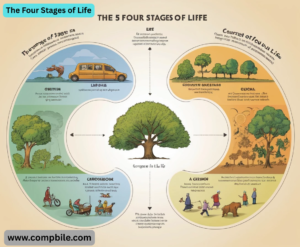
The Four Stages of Life Of course. The concept of “The Four Stages of Life” is a profound and recurring theme across cultures, philosophies, and psychology. There isn’t one single model, but several influential ones. Here’s a breakdown of the most prominent interpretations.
Common Themes and The “Fifth Stage”
While these models differ, they share a universal pattern:
- Learn & Prepare
- Act & Build
- Shift & Meaning
- Reflect & Transcend
Some modern thinkers argue for a “Fifth Stage” due to increased longevity. This stage, between the end of a traditional career and the onset of old age, is seen as a new period of active contribution, encore careers, and personal reinvention, often lasting 20-30 years.
Why These Models Matter
Understanding these stages isn’t about rigidly boxing your life into categories. Instead, they offer a valuable framework for:
- Normalizing Transitions: They help us see that the existential questions of midlife or the spiritual yearning of later years are not crises, but natural and expected phases of human development.
- Providing Perspective: They remind us that each stage has its own purpose and that it’s okay to let go of the priorities of a previous stage.
- Guiding Personal Growth: They encourage us to ask, “What is the central task of my current stage?” and “Am I preparing for the next one?”
The Deeper Meaning: A Journey of the Self
- At its heart, the concept of life’s stages is about the gradual transformation of identity. It’s a map of the soul’s journey from dependence to independence, and finally, to a state of transcendence or wisdom.
- The Outer Journey vs. The Inner Journey: The early stages (Student, Athlete, Householder) are primarily focused on the outer journey: building an ego, acquiring skills, achieving status, and fulfilling societal roles. The later stages (Hermit, Spirit, Renunciant) mark a crucial turn inward, toward the inner journey of self-knowledge, meaning, and connection to something larger than oneself.
Challenges and “Crises” at Each Stage
Each transition between stages is often marked by a period of turmoil, questioning, and growth—what we might call a “crisis.”
The First Transition: From Student to Householder (or Athlete to Warrior)
- The Challenge: Leaving the structured world of learning and stepping into the responsibilities of adulthood. This involves forming a stable identity separate from one’s family of origin.
- The “Crisis”: Quarter-Life Crisis. Questions like “Who am I?” and “What is my purpose?” dominate.
The Second Transition: From Householder to Hermit (or Warrior to Statement)
- The Four Stages of Life The Challenge: The Midlife Transition. The goals that once motivated you (a bigger house, a better job) may start to feel empty. You confront your own limitations and mortality.
- The “Crisis”: The classic Midlife Crisis. This is not just a cliché; it’s a profound psychological turning point. The question shifts from “How can I succeed?” to “Was it worth it? What does it all mean?” This is a necessary death of the ego to make room for a wiser self.
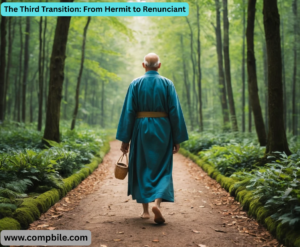
The Third Transition: From Hermit to Renunciant
- The Challenge: Letting go completely. This is the ultimate test of non-attachment—not just to material possessions, but to roles, relationships, and even one’s own body.
- The “Crisis”: The crisis of irrelevance. In a youth-obsessed culture, the elderly can feel cast aside. The spiritual challenge is to find value not in doing, but in being.
Cultural and Philosophical Variations
The theme of life’s stages is truly universal.
- Ancient Greek Philosophy: Philosophers like Pythagoras and Socrates described a similar four-stage model:
- Spring (0-20): Growth and learning.
- Summer (20-40): Action, ambition, and building a family.
- Autumn (40-60): Leadership, mentorship, and serving the state.
- Winter (60+): Reflection, wisdom, and preparation for death.
- Chinese Confucianism: While not as explicitly staged, Confucius famously said:
- “At fifteen, I set my heart on learning.
- At thirty, I stood firm.
- At forty, I had no more doubts.
- At fifty, I knew the mandate of Heaven.
- At sixty, my ear was obedient.
- At seventy, I could follow my heart’s desire without overstepping the boundaries.”
The Critical Concept of the “Two Halves of Life”
The psychologist James Hollens builds on Jung’s ideas to present a powerful simplification: life has two distinct halves.
- The First Half of Life (Approx. 0-40): The task is to build a healthy, functioning ego. Your mission is to create a container for your life: establish an identity, a career, a family, and a set of values. This is a necessary and heroic journey.
- The Second Half of Life (Approx. 40+): The task is to find the content that fills the container. If the first half is about building the wall of your identity, the second half is about discovering what’s inside the walls—and perhaps, paradoxically, discovering that the walls themselves were an illusion. The goal shifts from success to significance.
- The great tragedy, according to this view, is when people get stuck in the tasks of the first half, trying to build a bigger and better container (more money, more status) long after the container is solid, while ignoring the deeper hunger for meaning within.
Applying the Stages to Modern Life
How do these ancient maps help us today?
- It’s Non-Linear and Cyclical: You don’t simply “complete” a stage and move on. You may revisit lessons from earlier stages. A midlife career change might require you to become a “student” again. Becoming a grandparent can thrust you back into a “householder” role, but with a different wisdom.
- It’s a Tool for Self-Compassion: Understanding that you are in a natural stage of life can reduce anxiety. Feeling lost in your 20s? That’s the Student stage. Questioning everything at 50? That’s the necessary Hermit stage calling. You’re not failing; you’re developing.
- It Helps You Anticipate the Future: By understanding the trajectory, you can prepare. If you know the second half of life is about meaning, you can start cultivating interests, relationships, and spiritual practices now that will serve you later, making the midlife transition less “crisis” and more of a graceful shift.
The Shadow Side: When a Stage Goes Wrong
Each stage has its potential pathologies—ways we can get stuck or distorted.
- The Four Stages of Life The Perpetual Student: Someone who refuses to leave the first stage. They accumulate degrees but never engage with the real world, using learning as a shield against responsibility and risk.
- The Tyrannical Householder/Warrior: This person becomes obsessed with control, status, and material accumulation. They may sacrifice relationships, health, and integrity at the altar of “success,” becoming a caricature of the provider.
- The Midlife Meltdown (vs. Transition): A crisis becomes a meltdown when the individual tries to solve a second-half-of-life problem with a first-half-of-life solution. Instead of turning inward for meaning, they buy a sports car and pursue a much younger partner, desperately trying to recapture the feeling of the “Warrior” stage. This is the shadow of the Hermit—a refusal to let go of youth.
- The Bitter Hermit/Sage: Instead of moving into wisdom and acceptance, the individual becomes cynical, resentful of the young, and filled with regret. They see their life as a failure rather than a completed cycle. This is the stage of life that can produce deep misanthropy if the earlier stages are not integrated.
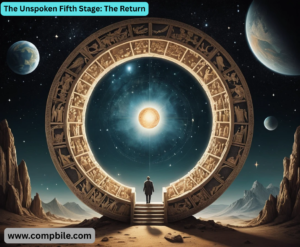
The Unspoken Fifth Stage: The Return
Many traditions hint at a final, almost mystical stage that transcends even the fourth. It’s not about withdrawal, but about a conscious return to the world with the wisdom of the cycle completed.
- The “Second Naivete”: Philosopher Paul Ricoeur wrote about moving from a “first naivete” (childlike belief) through a “critical distance” (skepticism, deconstruction), to a “second naivete”—a post-critical ability to believe, wonder, and engage with symbols and life, not out of ignorance, but with full awareness of their complexity. This is the childlike wonder of the sage.
- The Master in the Marketplace: This is the individual who has reached the highest stage of transcendence but chooses to re-engage with the world. They are in the world but not of it. Their actions are no longer driven by ego or desire but by compassion and spontaneous wisdom. Think of the retired CEO who now mentors young entrepreneurs for free, or the elder who becomes a beloved, gentle pillar of their community without seeking any credit.
- This Fifth Stage suggests that the ultimate goal is not escape, but integration—bringing the wisdom of the end back into the beginning, thus enriching the entire cycle.
The Gender Lens: Are the Stages Different?
- Traditional models (like the Hindu Ashramas) were explicitly designed for men. How do these stages apply to women, whose biological and social timelines have historically been different?
- The Householder Stage: For many women, the “Householder” stage of building a career and a family can be intensely compressed and conflicted, facing the “biological clock” and societal pressures that men do not experience in the same way.
- The Hermit Stage: A woman’s midlife transition (often coinciding with menopause) can be less about withdrawing from a public career and more about a powerful internal shift—a reclaiming of self after years of caring for others. It can be a stage of profound creative and personal unleashing.
- A Different Archetypal Journey: Some theorists suggest a different set of archetypes for women, such as Maiden, Mother, Matriarch, and Crone. The “Crone” archetype is not a negative one but a revered figure of wisdom, power, and freedom from the constraints of the maternal role.
- The universal themes of learning, building, meaning, and release are present, but the expression and timing are deeply influenced by gender and culture.
The Ultimate Paradox: The Stages Are an Illusion (and That’s the Point)
The most profound teaching hidden within these models is that the final stage is about realizing that the separate, striving self that progressed through the first three stages was always a temporary construction.
- The Student builds an identity (“I am a smart person”).
- The Householder/Warrior fortifies that identity (“I am a successful lawyer and a provider”).
- The Hermit/Statement sees the fragility of that identity (“My career will end, my body will age. Who am I without these roles?”).
- The Renunciant/Spirit transcends the identity altogether, realizing the self is part of a much larger whole.
- So, the journey is ultimately from unconscious unity (the infant), through conscious separation (the ego), to conscious unity (the sage). The stages are a beautiful, necessary game the soul plays to finally realize it was never confined by the game board in the first place.