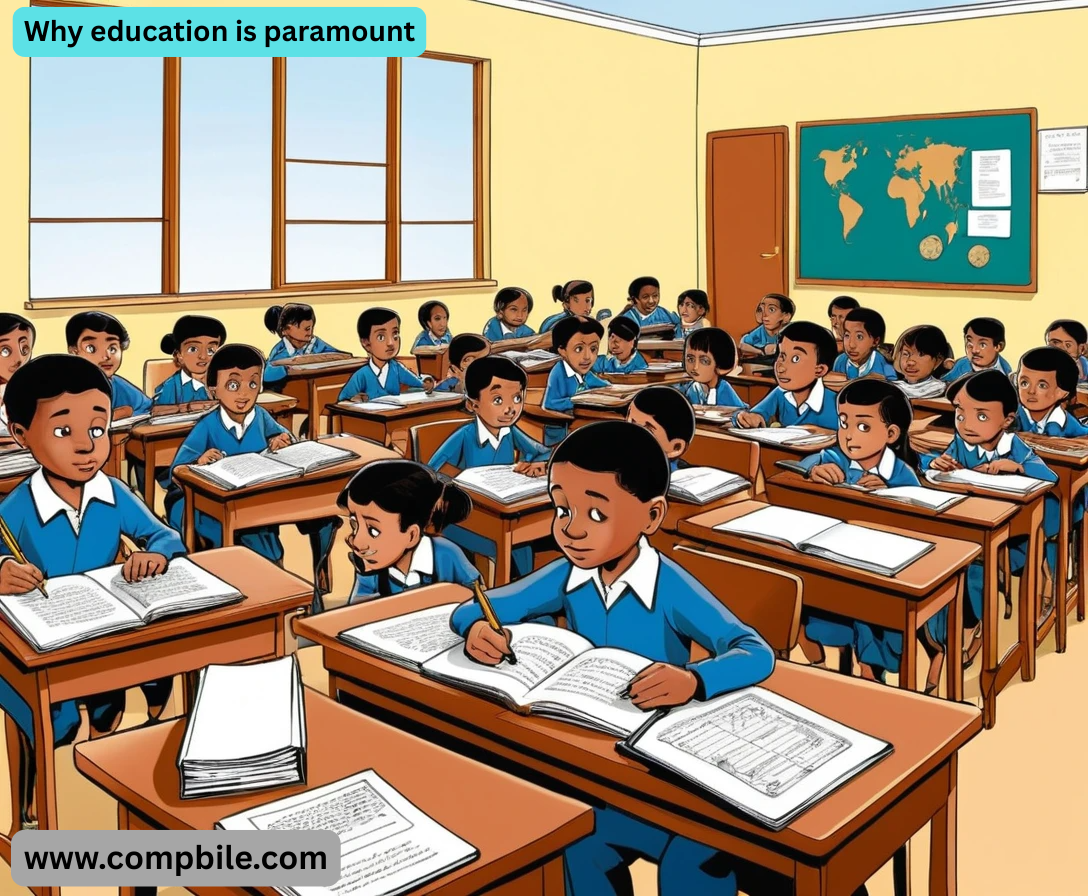
Why education is paramount Of course. Here’s a detailed breakdown of why education is paramount, exploring its importance from multiple angles.

For the Individual: Unleashing Human Potential
Education is the primary tool for personal development and empowerment.
- Cognitive and Critical Thinking Skills: It teaches you how to think, not what to think. You learn to analyze information, evaluate sources, solve complex problems, and make reasoned decisions. This is crucial for navigating an increasingly complex world filled with misinformation.
- Economic Empowerment and Opportunity: This is one of the most direct benefits. Education provides the knowledge and skills (e.g., literacy, numeracy, technical expertise) needed to secure better jobs, higher incomes, and economic stability. It is the most powerful engine for social mobility, allowing individuals to break cycles of poverty.
- Personal Development and Fulfillment: Education exposes you to new ideas, arts, cultures, and philosophies. It fosters creativity, curiosity, and a lifelong love of learning. This leads to a richer, more fulfilling inner life and a greater understanding of oneself and the world.
- Improved Health and Well-being: Educated individuals tend to make better health choices for themselves and their families. They have higher health literacy, understand nutritional information, and are more likely to use preventive healthcare services, leading to longer, healthier lives.
- Confidence and Agency: Knowledge is power. Being educated builds self-confidence and gives you the voice and ability to advocate for yourself, your family, and your community.
For Society: The Bedrock of Progress
A educated populace is essential for a functioning, prosperous, and harmonious society.
- Informed Citizenship and Democracy: For a democracy to thrive, its citizens must be informed. It enables them to engage in civic discourse, vote wisely, and hold leaders accountable, protecting society from demagoguery and authoritarianism.
- Social Cohesion and Tolerance: Schools are often the first place where children meet people from different backgrounds, cultures, and religions. Education promotes understanding, empathy, and tolerance. It teaches shared values like respect and cooperation, reducing prejudice and social conflict.
- Economic Growth and Innovation: No country can thrive with an unskilled workforce. Education creates the scientists, engineers, doctors, teachers, and skilled tradespeople who drive economic growth, technological innovation, and global competitiveness. It is the foundation of a modern economy.
- Reducing Social Ills: Higher levels of education in a population correlate strongly with lower rates of crime, poverty, and dependency on social welfare programs. Educated communities are more stable and safer.
- Adaptability and Resilience: In a world rapidly changing due to technology and globalization, education systems equip societies with the skills to adapt, retrain, and face new challenges like climate change and economic shifts.
For the Future: Solving Global Challenges
The most pressing problems humanity faces cannot be solved without education.
- Climate Change and Sustainability: Solving the climate crisis requires a global population that understands science, believes in evidence, and can develop and implement green technologies. Environmental education is key to creating sustainable societies.
- Global Health: From managing pandemics to eradicating diseases, education is on the front line. It enables the training of healthcare workers and ensures public health messages about vaccination, sanitation, and prevention are understood and followed.
- Technological Advancement: The future will be built on AI, biotechnology, and quantum computing. We need a robust educational pipeline to create the experts who will steer these technologies ethically and effectively for the benefit of all.

The Counterargument: What About “Schooling” vs. “Education”?
Critics rightly point out that:
- Some school systems can be outdated, stifling creativity and critical thinking.
- Rote memorization is sometimes prioritized over practical skills.
- Access to quality education is not equal, often reflecting and reinforcing existing social inequalities.
- However, these are criticisms of how we educate, not the value of education itself. The goal should be to reform and improve educational systems to truly fulfill their paramount purpose.
Metacognition: Learning How to Learn
- In a world where information is obsolete quickly, the most critical skill is the ability to learn, unlearn, and relearn. This self-reflection allows individuals to become autonomous, lifelong learners, adaptable to any new challenge or career shift.
The Engine of Equality and Social Justice
- It provides a pathway for marginalized groups (whether by economic status, gender, race, or geography) to claim their place in society. By equipping everyone with knowledge and critical thinking, it empowers them to question unjust structures, challenge biases, and advocate for their rights. It is a fundamental tool for dismantling systemic inequality.
Cultural Transmission and Evolution
- Why education is paramount Education is how a society passes its collective knowledge, history, and cultural heritage to the next generation. By critically examining our history and culture, education allows societies to learn from past mistakes, evolve their values, and progress.

Fostering Resilience and “Anti-Fragility”
- A good education doesn’t shield people from difficulty; it prepares them for it. Through overcoming academic challenges, working in teams, and facing criticism, individuals build resilience. This creates “anti-fragile” individuals and communities that grow stronger when exposed to volatility and stress.
The Critical Distinction: Education vs. Schooling
This is perhaps the most important nuance in this discussion. They are not synonymous.
- Schooling is the formal, structured process of instruction, typically within an institution. It’s a system.
- Education is the outcome—the acquisition of knowledge, skills, and wisdom. It can happen anywhere: in a library, a workshop, a conversation, or through life experience.
- Why this distinction matters: A flawed system of schooling can sometimes actively hinder true education. This is the source of valid criticisms:
- “The Factory Model”: Outdated systems designed for the Industrial Age that prioritize conformity, rote memorization, and standardized testing over creativity and critical thinking.
- Inequitable Access: The “paradox of education” is that while it is a tool for equality, access to quality education is often deeply unequal, perpetuating the very divides it is meant to bridge.
- Curricular Gaps: Many systems fail to teach essential modern life skills like financial literacy, digital citizenship, and emotional intelligence.
- Therefore, when we say “education is paramount,” we are advocating for the outcome and must remain critical of the systems meant to deliver it. The goal is to reform schooling to better serve true education.
The Shift from Knowledge Retrieval to Knowledge Application:
- If an AI can instantly recall all known facts, then education can no longer be about memorization. Its value shifts to:
- Creative Synthesis: Can you combine ideas from different fields in novel ways that an AI wouldn’t think of?
- Ethical Reasoning: Can you make moral judgments about how to use the information and technology?
- Human-Centric Skills: Empathy, collaboration, leadership, and storytelling become uniquely human and highly valuable.
- In this new context, education is paramount because it is the process of cultivating distinctly human intelligence.