
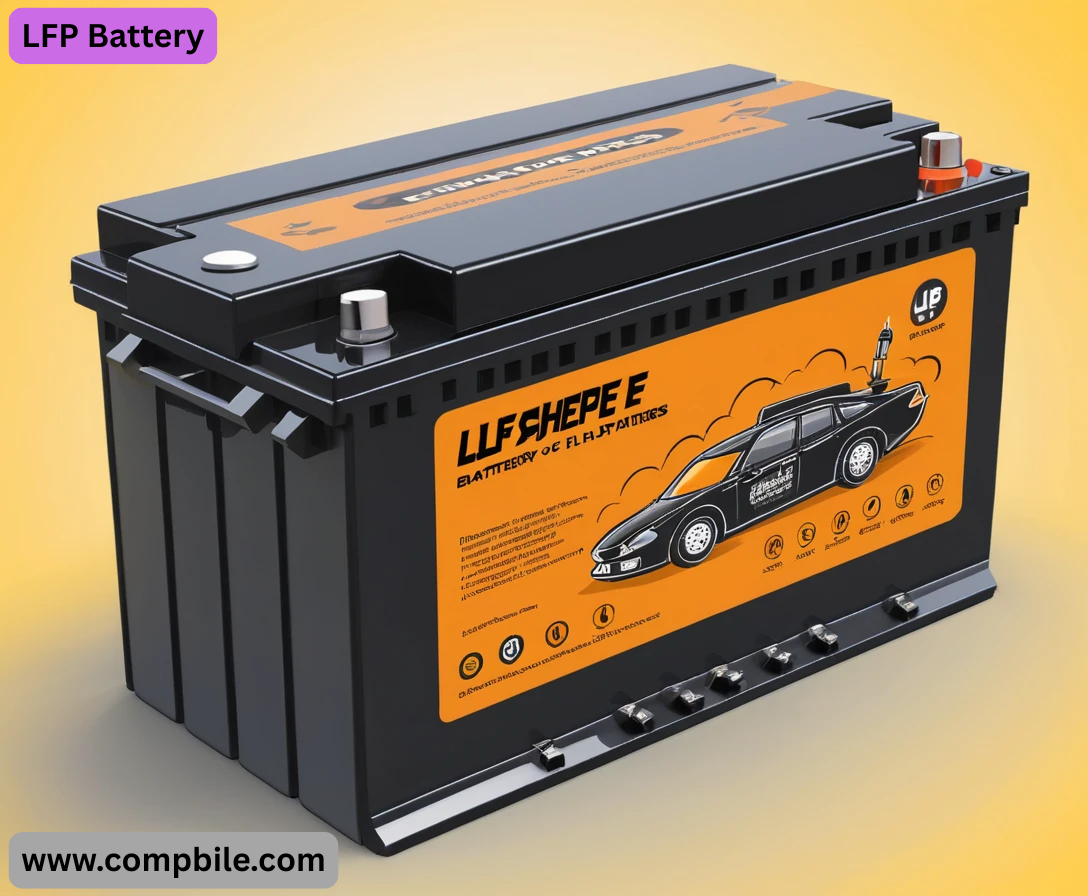
LFP Battery Of course. Let’s break down everything you need to know about LFP Batteries.

What is an LFP Battery?
- LFP stands for Lithium Iron Phosphate. It’s a type of lithium-ion battery that uses Iron (Fe) and Phosphate (PO₄) as the cathode material, as opposed to other common chemistries like NMC (Lithium Nickel Manganese Cobalt Oxide) or NCA (Lithium Nickel Cobalt Aluminum Oxide).
- The chemical formula for the cathode is LiFePO₄, which is why you’ll often see it called a “LiFePO4” (pronounced “life-p-o-4”) battery.
Key Advantages of LFP Batteries
- LFP chemistry has become incredibly popular, especially in recent years, due to its distinct set of advantages:
Exceptional Safety:
- Highly Stable Chemistry: The phosphorus-oxygen bonds in the cathode are strong and remain stable at high temperatures. This makes LFP batteries much more resistant to thermal runaway (the process that leads to fires and explosions).
- Lower Risk: They are far less likely to catch fire, even if punctured, overcharged, or physically damaged, compared to NMC batteries.
Long Cycle Life:
- LFP batteries can typically withstand 3,000 to 5,000 charge cycles (and in some cases, even more) before their capacity significantly degrades.
- For comparison, a good NMC battery might last 1,000 to 2,000 cycles. This makes LFP an excellent choice for applications where the battery is charged and discharged daily.
Cost-Effectiveness:
- The raw materials—Iron and Phosphate—are abundant, cheap, and geographically widespread. This avoids the supply chain issues and high cost associated with Cobalt and Nickel used in NMC batteries.
High Power Output:
- They can deliver high discharge currents (high C-rates) without significant damage. This makes them ideal for applications requiring a lot of power in a short burst, like powering high-wattage appliances or electric vehicle acceleration.
Environmentally Friendlier:
- The absence of cobalt and nickel is not just a cost benefit; it’s also an ethical and environmental one. Cobalt mining, in particular, has been linked to serious human rights concerns.
Disadvantages of LFP Batteries
- No technology is perfect, and LFP has some trade-offs:
Lower Energy Density:
- This is the main drawback. LFP batteries store less energy per unit of volume or weight than NMC batteries.
- Practical Implication: An electric vehicle with an LFP battery pack will typically have a slightly shorter range for the same physical size/weight of battery, compared to an NMC pack.
Lower Nominal Voltage:
- LFP cells have a nominal voltage of ~3.2V – 3.3V, compared to ~3.6V – 3.7V for NMC.
- This means you need more cells in series to achieve the same pack voltage (e.g., for a 48V system, you need 16 LFP cells vs. 14 NMC cells).
Performance in Cold Weather:
- LFP batteries are more sensitive to cold temperatures. Their performance and ability to accept a charge drop significantly in sub-zero conditions (though this can be managed with built-in heating systems).
Common Applications
LFP’s strengths make it the ideal choice for many applications:
- Electric Vehicles (EVs): Companies like Tesla (for its standard range models), BYD, and others are massively adopting LFP batteries. The safety, long life, and cost savings often outweigh the slightly lower range for mass-market vehicles.
- Energy Storage Systems (ESS): For home solar storage (e.g., Powerwalls) and grid-scale storage, where safety, cycle life, and cost are paramount, LFP is the dominant chemistry.
- Marine and RV Applications: The safety aspect is critical in confined spaces, and the long cycle life is perfect for daily off-grid use.

Golf Carts and Low-Speed Electric Vehicles:
- Portable Power Stations: Many popular consumer power stations from brands like Anker, EcoFlow, and Bluetti now use LFP batteries due to their safety and longevity.
Advanced Technical Deep Dive
The Olivene Crystal Structure
- The secret to LFP’s stability lies in its cathode’s atomic arrangement. The LiFePO₄ crystal forms a olivine structure (named after the gemstone). This structure is very robust because:
- The strong P-O covalent bonds are difficult to break, preventing oxygen release even under abuse.
- Lithium ions move through one-dimensional channels within this structure. While this contributes to LFP’s stability, it originally limited its rate capability (how fast it can charge/discharge).

The Nanocoating Revolution (Carbon Coating)
- Early LFP batteries had relatively poor performance because the olivine structure has low electrical conductivity. The breakthrough was nano-engineering:
- The LiFePO₄ particles are ground down to an extremely small, nano-scale size.
They are then coated with a thin layer of conductive carbon.
- This dramatically shortens the path for lithium ions and electrons to move, solving the conductivity problem and enabling the high power output LFP is known for today.
Voltage Profile: The Flat Curve
- An LFP cell has a very flat discharge/charge voltage curve, typically between 3.2V and 3.3V for most of its capacity.
- Advantage: Provides stable voltage to devices, which is excellent for powering motors or inverters.
- Challenge for BMS: It makes it very difficult for a Battery Management System (BMS) to determine the State of Charge (SOC) precisely based on voltage alone. Advanced LFP BMS units often use Coulomb Counting (tracking the current in and out) as the primary method for SOC estimation.
Market Trends & The Future
Dominance in Stationary Storage
- LFP is now the undisputed leader in the energy storage system (ESS) market. Its safety (critical for a device in your garage or basement) and long cycle life (directly translating to a lower “cost per cycle”) make it the ideal choice.
The EV “Tipping Point”
The automotive industry is undergoing a massive shift:
- Tesla: Now uses LFP batteries in all its Standard Range models globally.
- Ford: Announced an LFP version for its Mustang Mach-E and F-150 Lightning to offer a lower-cost option.
- VW, Rivian, and others have announced plans to adopt LFP.
- BYD’s “Blade Battery”: A revolutionary LFP pack design that improves space utilization (volumetric energy density), addressing one of LFP’s key weaknesses and proving its viability for modern, long-range EVs.
Supply Chain Independence
- For Western countries, LFP offers a path to reduce reliance on Chinese-dominated NMC supply chains. The materials for LFP (iron and phosphate) are globally abundant, allowing for more localized and secure battery manufacturing.
Practical User Guide: Charging & Maintenance
- Charging Specifications (for a typical 12V LFP battery or 4-cell pack):
- Bulk/Absorption Voltage: 14.2V – 14.6V (This is the constant-current phase where the battery takes most of its charge).
- Float Voltage: 13.5V – 13.8V (Once charged, the voltage is lowered to maintain the battery without overcharging).
- Cut-off/Discharge Voltage: 10V – 12.0V (Avoid discharging below this; a BMS will typically disconnect to protect the cells).
Why a Specialized Charger is Critical
- You must use a charger designed for LFP chemistry. Using a lead-acid charger will not optimize performance and can be dangerous. LFP batteries have very low internal resistance and will accept charge at the charger’s maximum current until almost full, which a lead-acid charger is not designed for.